This didn’t include any jerrys , and the front tank was still on a quarter


This didn’t include any jerrys , and the front tank was still on a quarter
And thus the marketplace he carefully scoured,
mindful of the pitfall that he could be devoured
by a horse trader of such dubious disposition
that even his most vigilant premonition
would serve him to no end!
His search for a wagon or vehicle of sort,
that would ferry him overland without abort
became a tiring quest that eventually
lead him, to speak figuratively and literally,
on the path to his first discovery!
For as he patiently roamed the town
a billboard suddenly stared him down!
“Land Rover” it glowed so brilliantly bright
that in his mind it triggered a light!!
“Of course, just what I need to rove the land!”
Thus in he went and bought a Landy
with which he felt extremely dandy!
And as proudly he ‘roved’ down the road
he felt just like the old fairytale Toad
about to be kissed by the Princess!
In his Discovery he set out to acquire
everything that his exploration would require!
From tents and blankets, pots and pans,
to a rack for the roof and some jerrycans!
“Dr Livingstone I presume!”
And finally he and his Randy Lover,
was ready to take to the wild to discover!
Poor fellow, little did he know
that now his bitterest woe
was about to commence!
At first the Rover went like a charm
and in driving fast he saw no harm!
Across the road he went at speed,
proud on the trot like a noble steed!
Until he reached the outskirts of town!
Its a long story that from here onwards ensued
in which frustration overrun the poor dude!
From daybreak to the middle of the night,
everything went wrong and nothing right!
Reliability, oh Reliability! Where art thou?
However, in all fairness it is a fact
that the LR crowd improved their act!
And before the crack of the following day,
a replacement Disco was on its way!
And finally he could leave the outskirts of town!
Low and behold, the LR replacement
smacked of a good improvement!
On he charged, off the road into the rough,
the Landy was made to go this tough!
Let the fun and games begin!
And so the replacement Disco took him far,
away from the town and far from the tar!
Way into the world of all wheel drive,
where only the Overland Manne thrive!
Here the best have to prove their mettle!
Far off the tar another chapter was written,
because our LR man was overly smitten
with his machine’s ability to tackle the wild,
which soon he would learn is rather mild.
He was still to meet Mr Experience!
Like a vicious lion the Disco roared,
and up and over the dune it soared!
With hill descent, traction and terrain control
the Landy was unstoppable on a roll!
Oblivious to the beginning of the end!
Invariably grey matter will always gain
the upper hand over the virtual domain!
Thus the ‘digital driver’ is doomed to fail
where flesh, blood and experience prevail!
Enter the 21st Century Land Rover!
The rest is now history of the past
for the Landy fell quite quickly and fast!
Burried up to its belly in grime and grit,
the Disco dumped its driver in the (censored)!
The digital driver out of its depth!
The day went on and the shadows long,
our Landyman now not quite so strong.
The dark of nightfall was not the fear,
but how to get the Disco out in the clear!
This is not a situation you wish for foe or friend!
But then the Discoman froze into a poise!
Was that just imagination, or really a noise?
Yes, the noise grew unmistakably clear,
someone else was drawing near!
One very relieved Discoman!
With the deep baritone drone of six in a row,
the four and a half EFI (SFA) glided to a slow!
A calloused hand reached out in comprehension
with a gesture of typical ‘Overland’ compassion!
The Discoman thanking his lucky star!
The thirty three muddies mauled the earth,
as the Disco slowly lifted from its berth!
The six-man squad showed little strain,
in helping the Disco onto level plane.
Then it was time to dig into the Luna!
With darkness now calling the shot,
it looked like a decent camping spot!
Unceremoniously a howling moon and eazi awn
were summoned to duty till the crack of dawn!
The Luna’s lid worked overtime without complaining!
Later, as the Kameeldoring flames licked the sky,
the Discoman gathered the courage to ask: Why?
What makes the difference more or less,
of Yota’s unquestionable superior success?
The Yotaman sipped his fizz and smiled.
Is it the men, Old Emu or Ironman, he wanted to know,
that always help Yota to steal the show?
Or is it quite simply plain
the size of your muddies or all terrain?
The Yotaman sipped his fizz and cleared his throat!
With wisdom gleaned from many a day
the Yotaman prepared the final say!
Leaning over to the Landyman’s closest ear,
“Elementary my dear Discoman”, he said for only him to hear:
“The ultimate secret is not to Rove,…….but to Cruise!”
This was my first “real” overlanding trip in Bo . We were joined by:
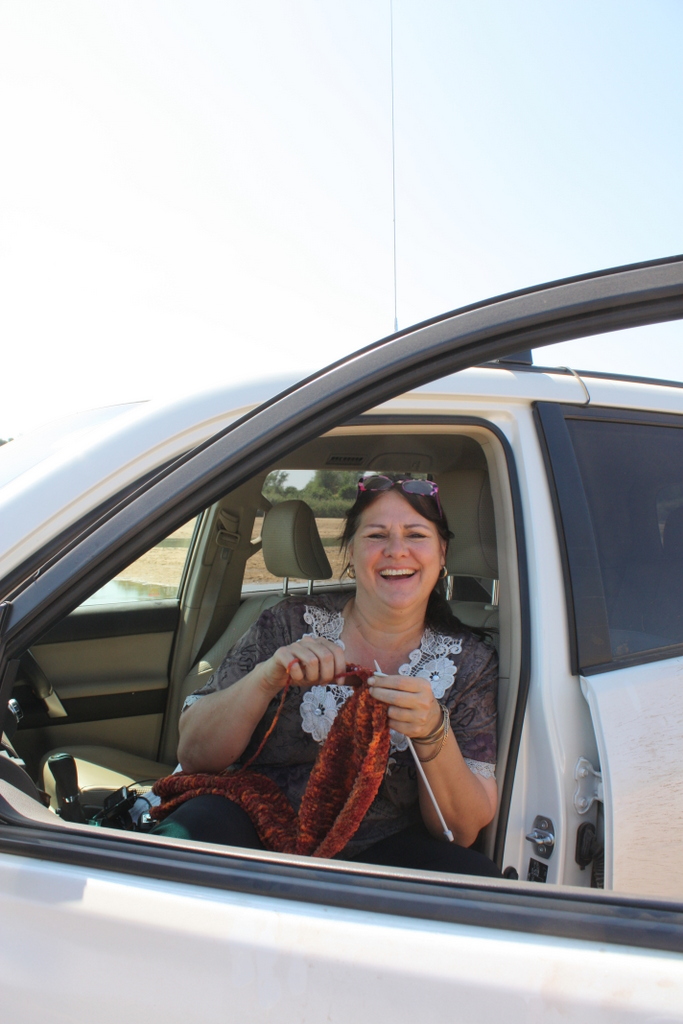
Nick and Hester Coetzee – V6 Prado + Echo Trailer

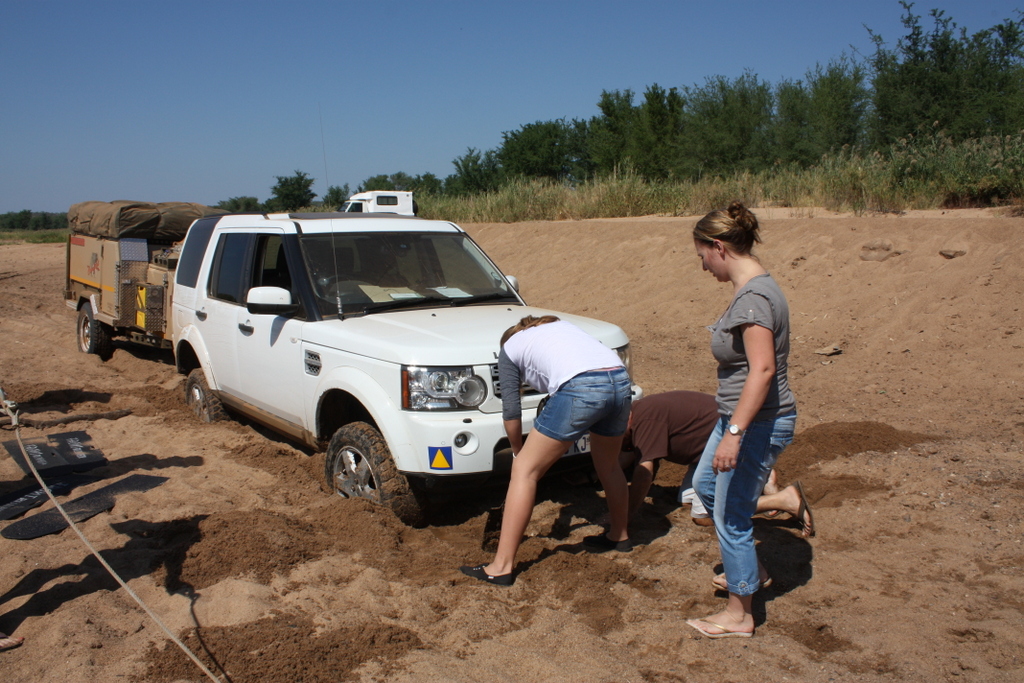
Damian,Lydia and Nikita Stander – Discovery 4 SDV6 + Conqueror Trailer
Phillip and Dena Sprules – Defender 130 TD5

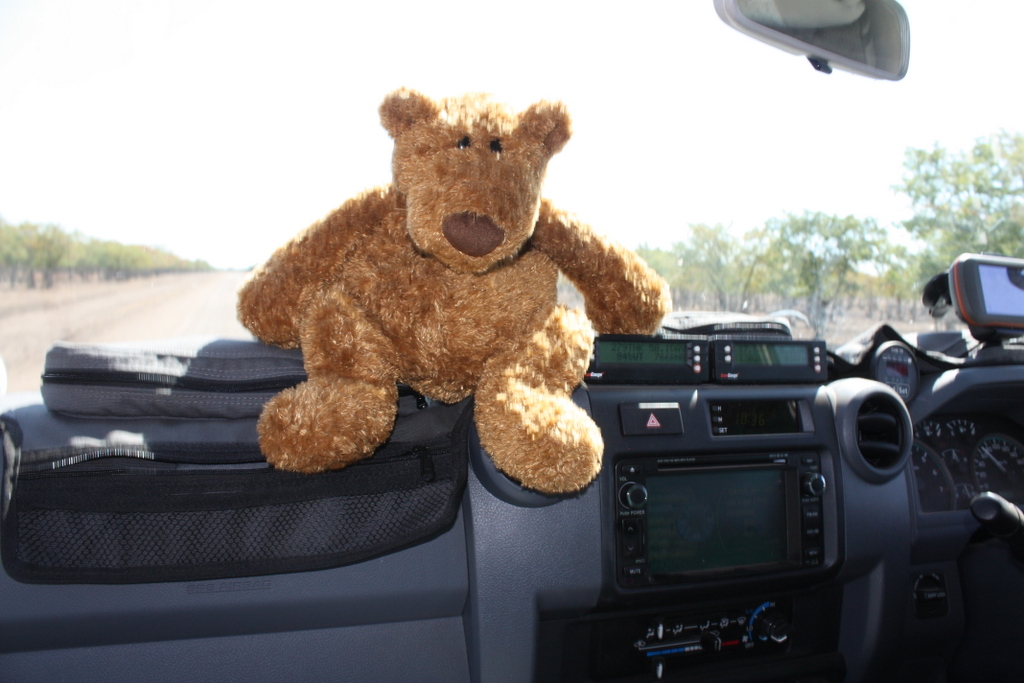
and of course Jagie Bear
Day One 26 April
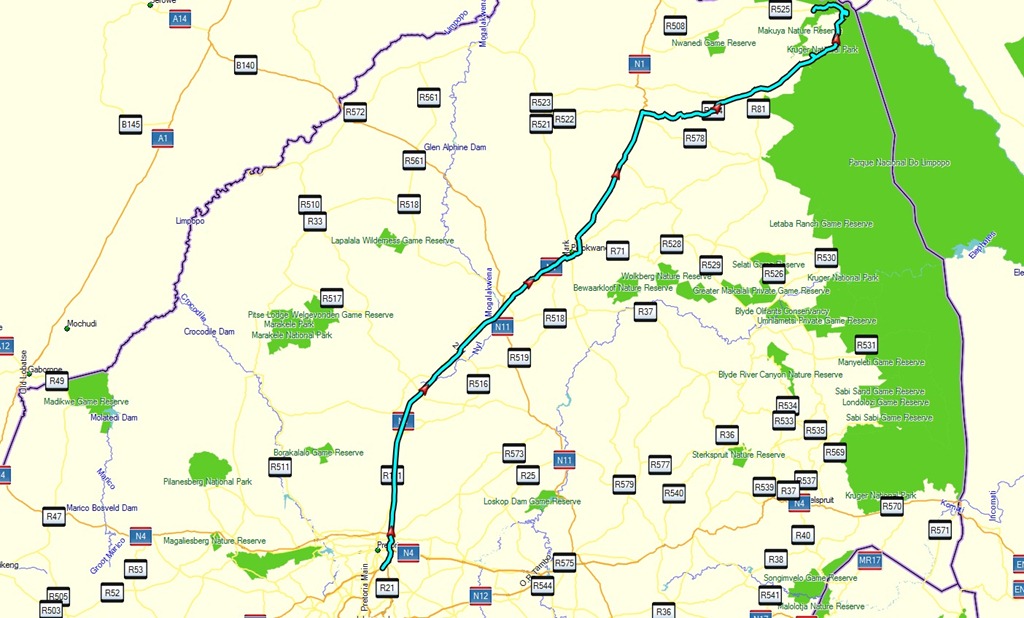
We left home at about 5 AM and met up with the rest of the guys at the Petroport north of Pretoria. After stopping for breakfast at the Ultra City outside of Polokwane we headed for Louis Trichardt where we filled up and then into Kruger via the Punda Maria gate
We thought about having lunch at the restaurant, but I had an early taste of Zimbabwe in that my first, second and third choices on the menu were out of stock. This in addition to the credit card machine not working. We filled up with fuel and headed to Pafuri River Campinstead after a brief detour through the park.

Tree house option on the river
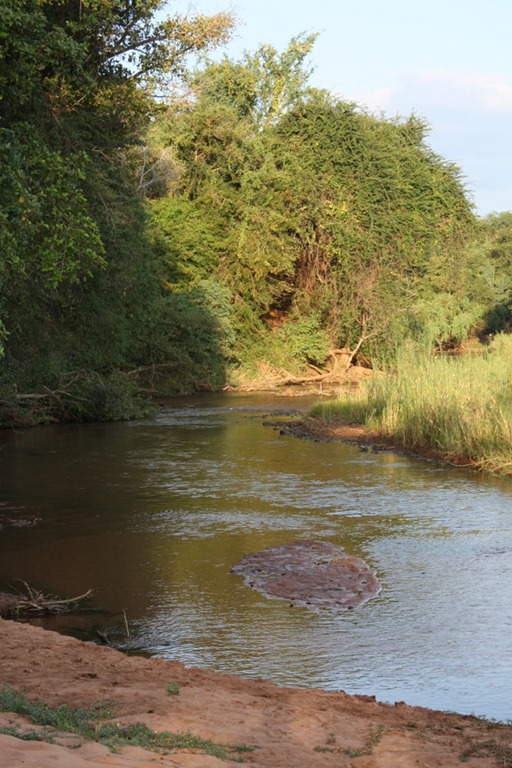
River view from the campsite
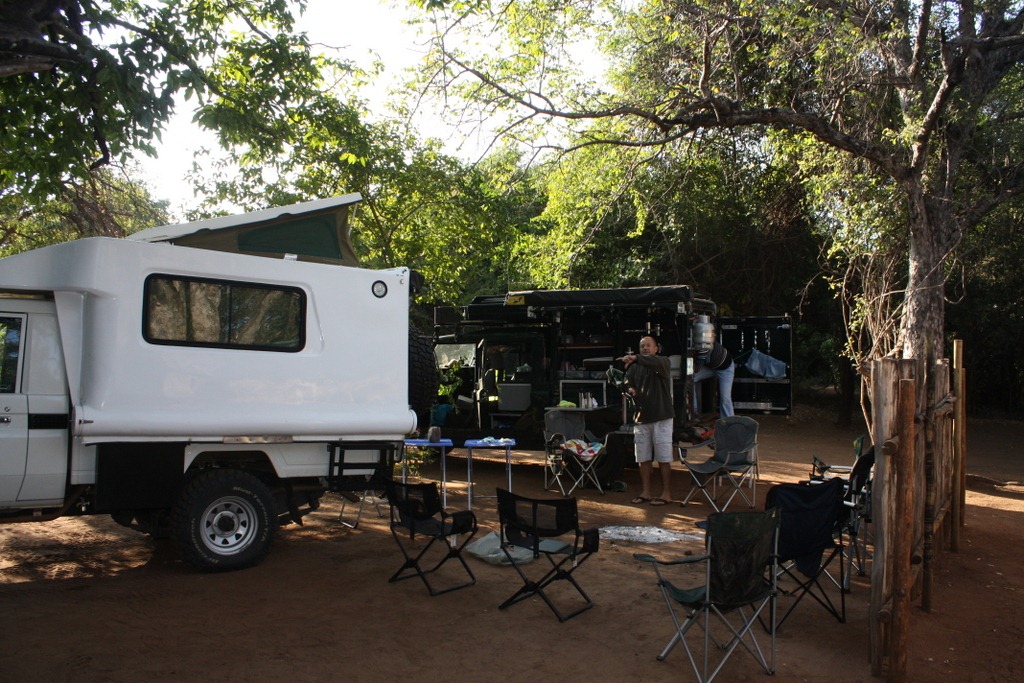
Our campsite
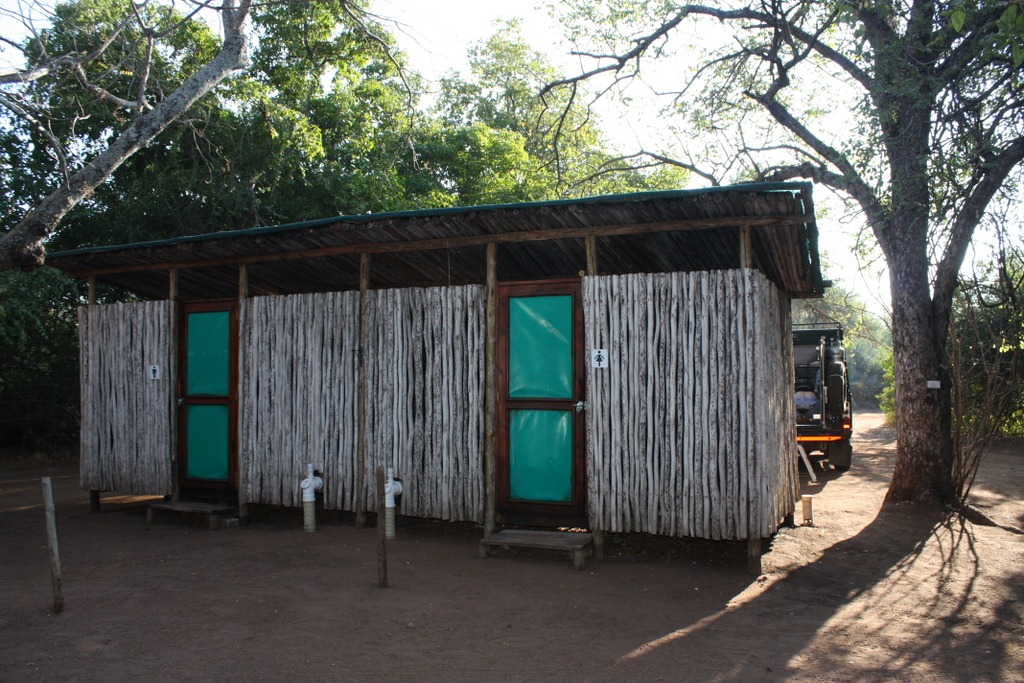
And private showers / toilets
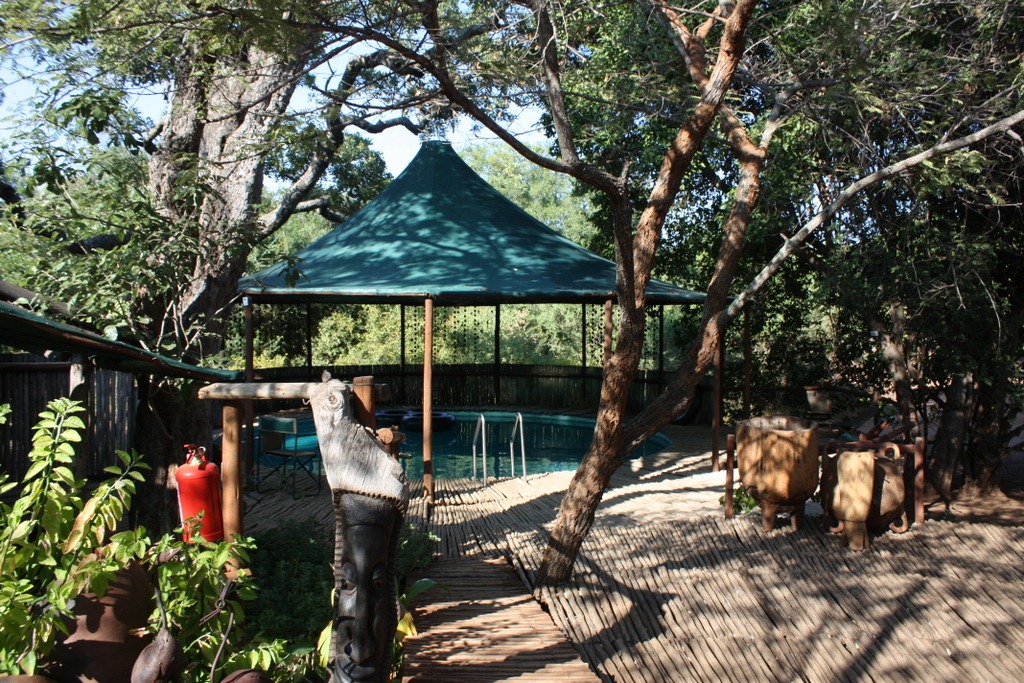
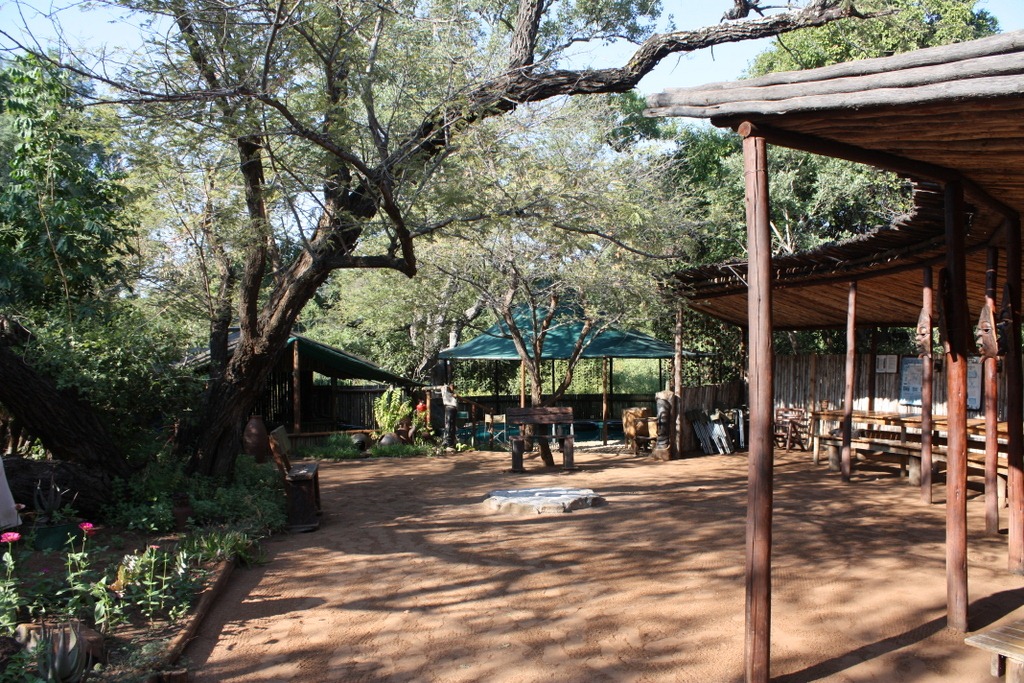
The bar and pool area
Very reasonably priced at R90 per person. You can also have meals in the bar area
Day Two 27 April
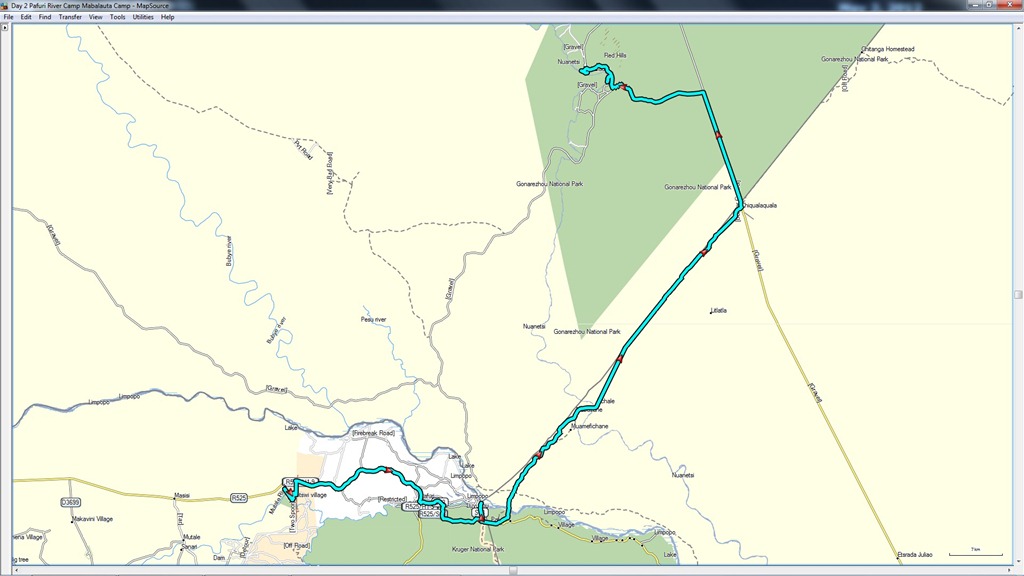
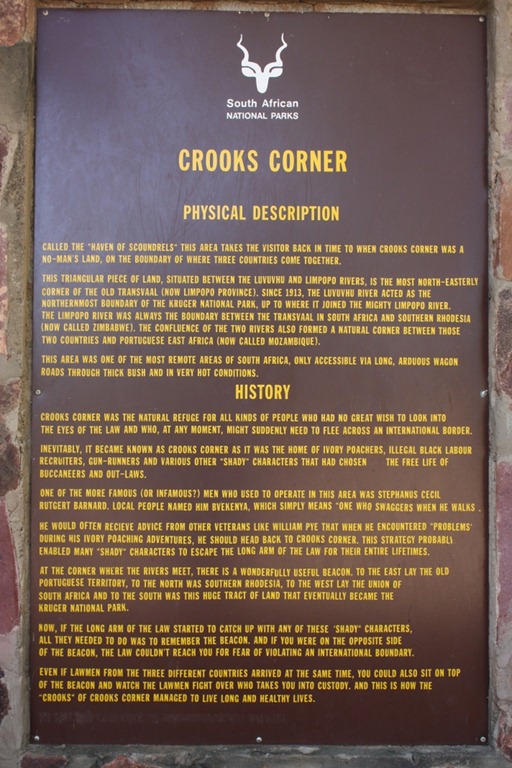
After a slow start, because we had a fairly short day ahead (yeah right), we headed back into the park to the Pafuri Border Post, after a short stop at Crook’s Corner.

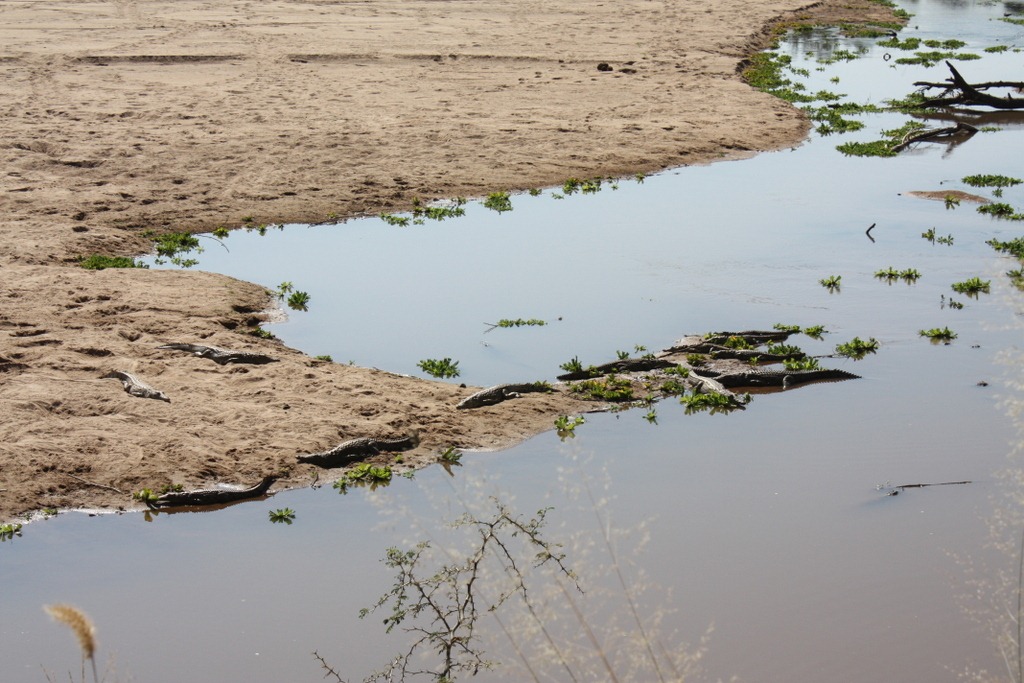
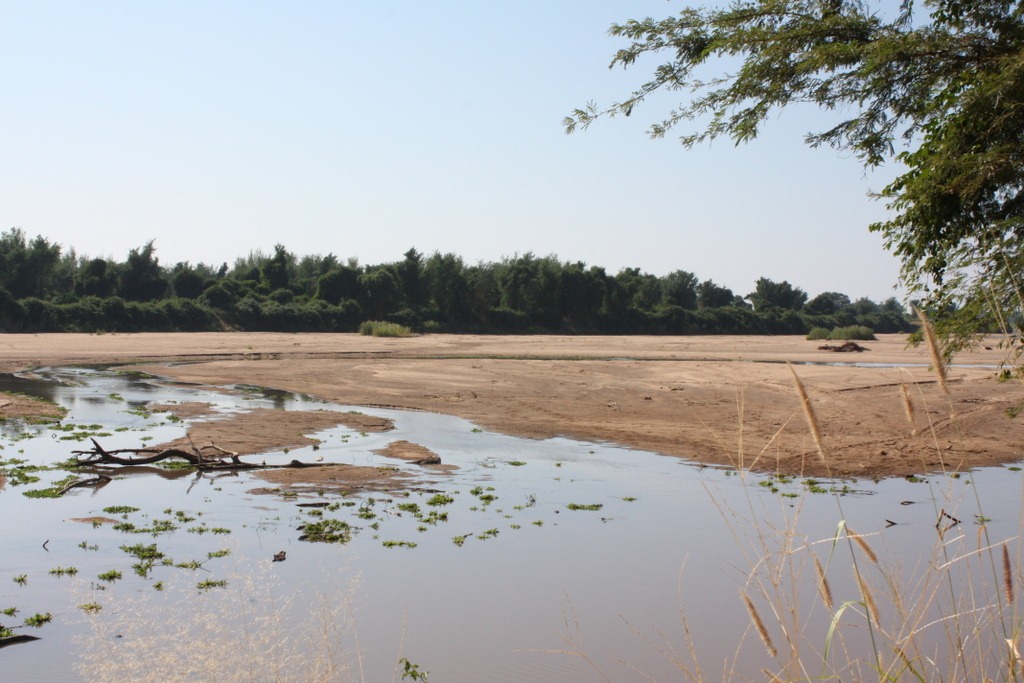
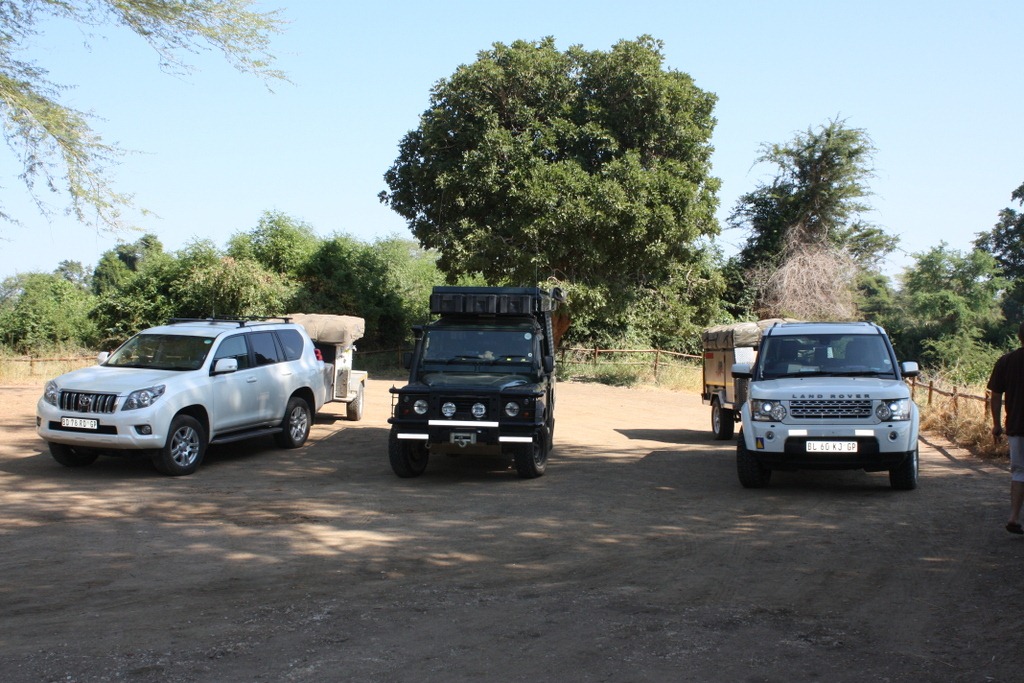
The border crossing went quickly enough, probably sped up by the fact that I paid an “import fee” for food and alcohol on the Mozambique side without realising it. Apparently Phillip had been “charged” but was refusing to pay, when I happily came along and paid it without question. In my defence I thought I was paying for road tax or something.
We headed to the river crossing and were relieved to see that the river was very low and I thought that we would be across very easily.

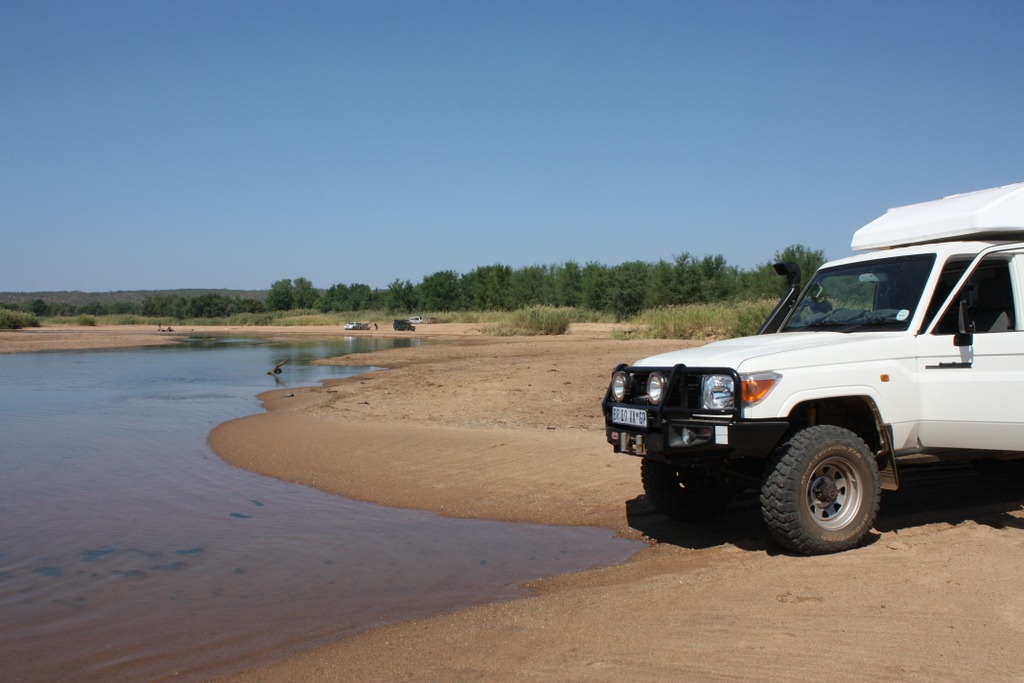
Bo at rivers edge (and in 2wd high range I might add – the torque on this engine is awesome)

The rest ready and waiting

Filly done
That’s however when the fun started.
Damian drove onto the river bank and promptly got stuck, which was probably my fault as we were not on the main track. The next 3 and a half hours were spent in alternatively recovering him and Phillip who got stuck helping him out.


Damian out – now for the trailer (notice how high the car stands in “super extended mode”)

Trailer winched out

All hooked up again – with Filly in the lead – off we go !

But not for long
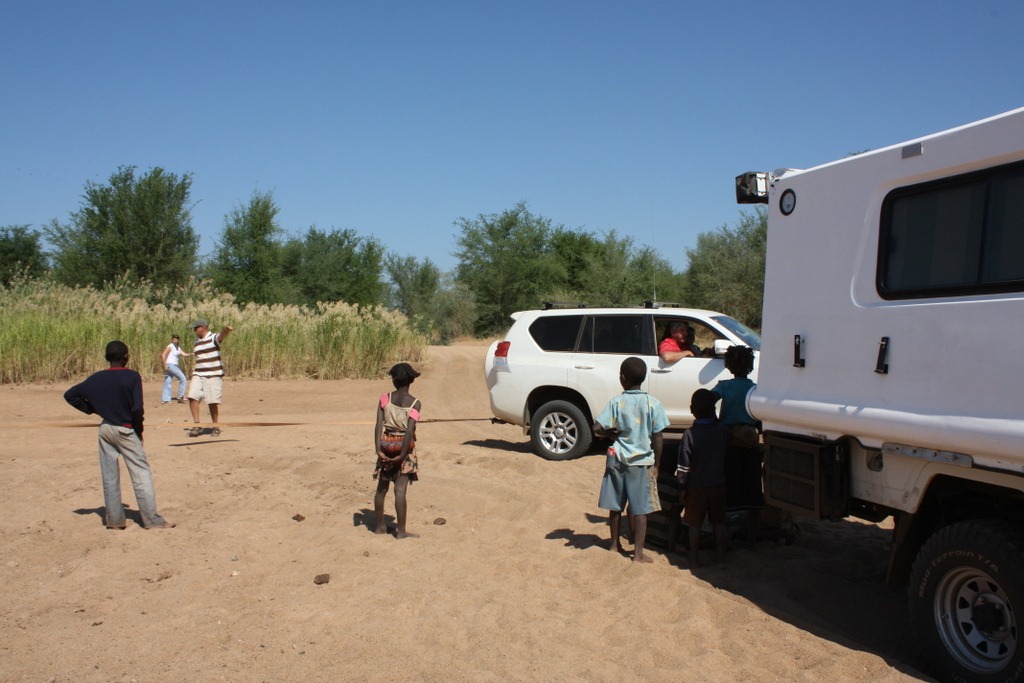
Nick helping Filly help Damian
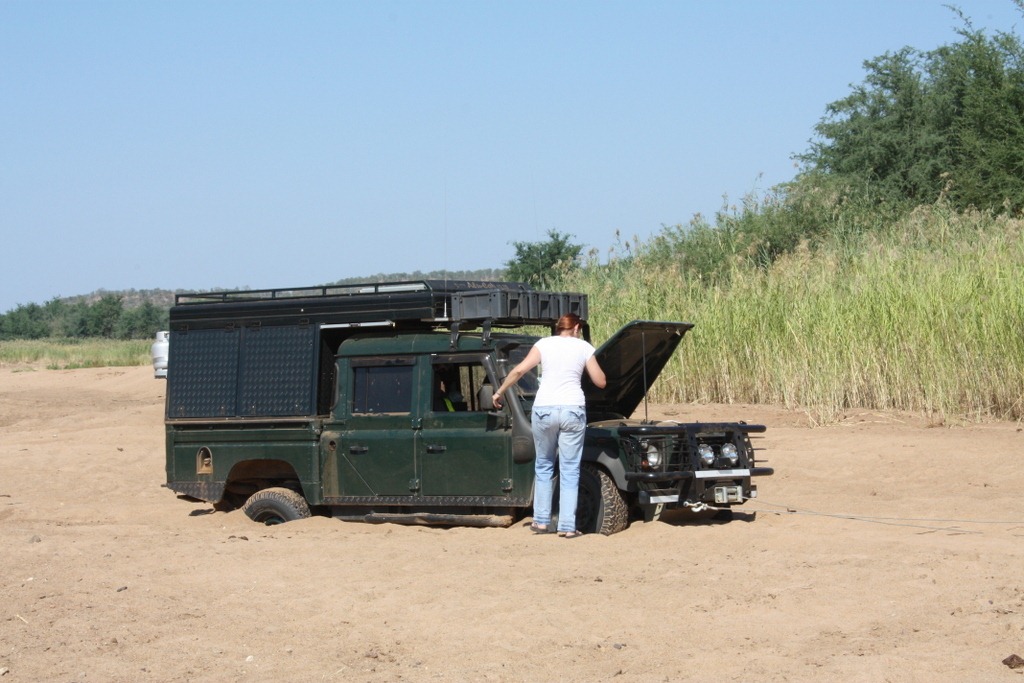
But not for long – eventually we had to winch Filly out with a snatch block

Out at last .
We eventually got Damian over the river and then went back for the trailer . As good as the D4 is , it really battled with a 1 ton plus trailer in thick sand . Luckily Damian was with friends ….. 
After some fun in the sun, we headed for Sango Border Post, after first helping a local out the river bank.
We reached Sango at about 4.30 and were across quickly on the Mozambique side. The Zimbabwe side went quite quickly as well, until we reached the exit gate.
Here the police battled to find engine numbers on all of our cars until it was past 6 O’clock (note to self, must remember to find it for future reference).
As it was now past 6,we were told we would have to wait until tomorrow, as they were now off duty, despite the fact that the border was open until 8. The other option would be to “assist ” them. So R150 and two beers later we were through the gate.
While I normally refuse to pay bribes, it was apparent that we weren’t going to get through that night, any other way.
We then looked for the closest accommodation on the GPS, which was Simwunini.
It turned out that there was no camping, only chalets. We then continued to Mabalauta where we drove around a bit until we found the guard who allowed us in after a bit of persuasion (no money this time though) and a promise to book in the next day.
We finally set up camp at about 8 pm, 11 hours and 138 km after leaving Pafuri
Day 3 28 April

Spent a quite day around the campsite, only going out for a late afternoon drive. We didn’t see much, other than a herd of elephant.
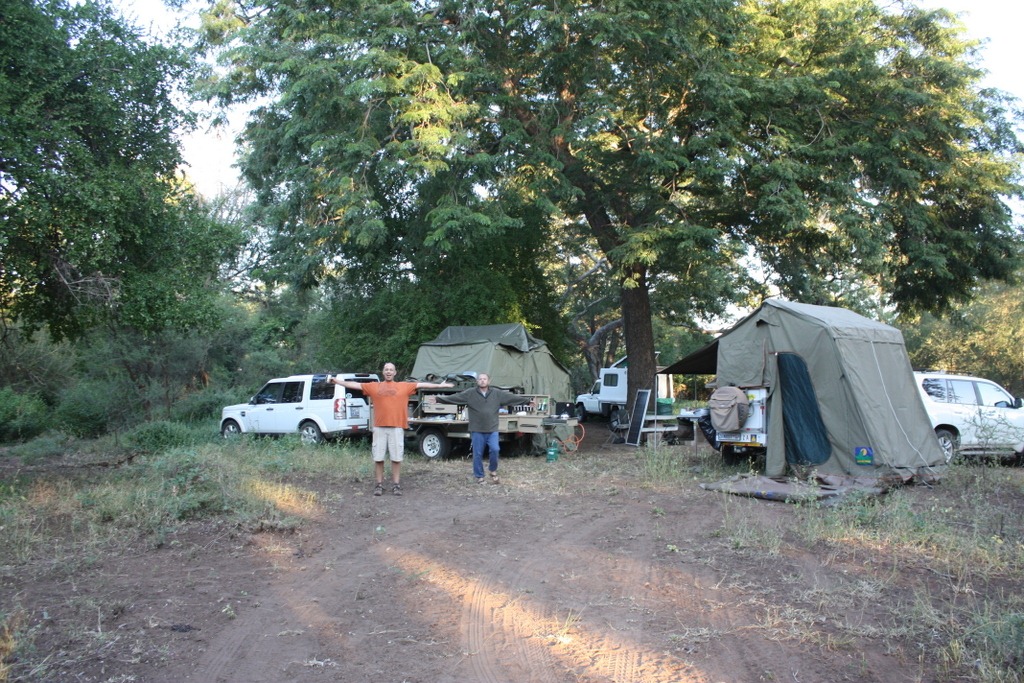
Very nice campsite with lots of shade
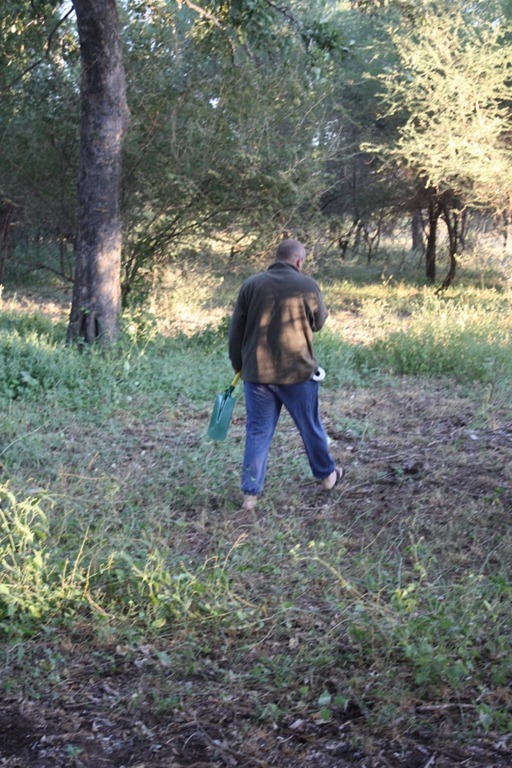
This was before Filly discovered there was an ablution block 
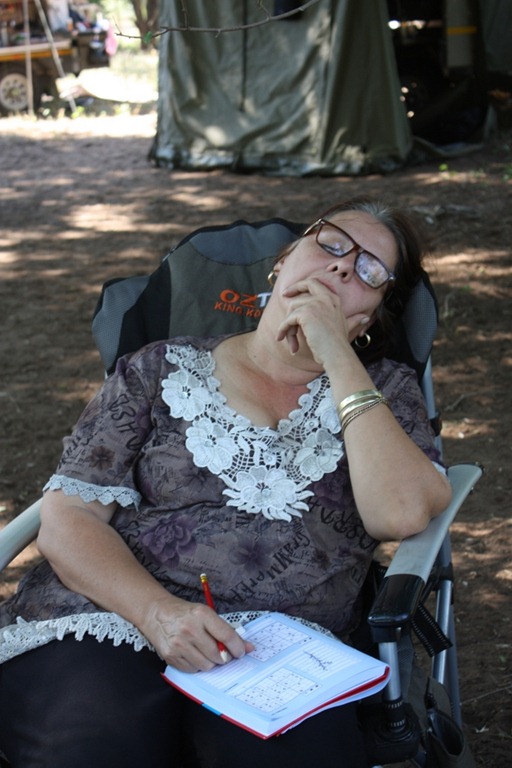
The previous day caught up with Hester
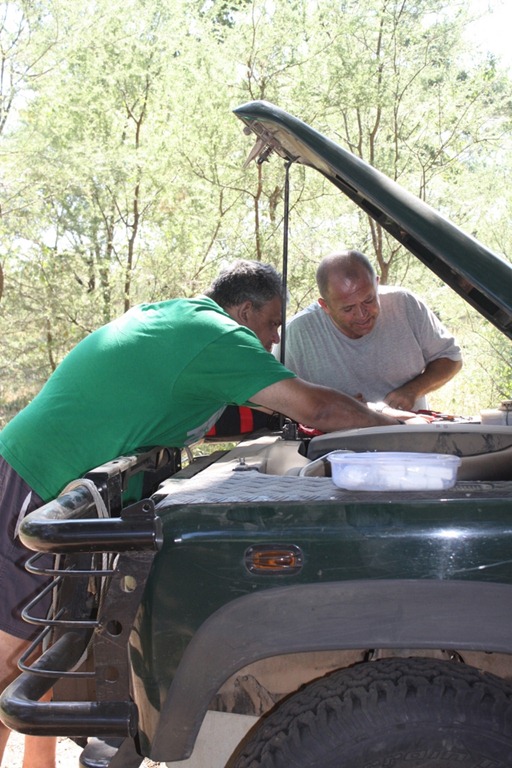
What would a trip be without a Landy with an open bonnet 
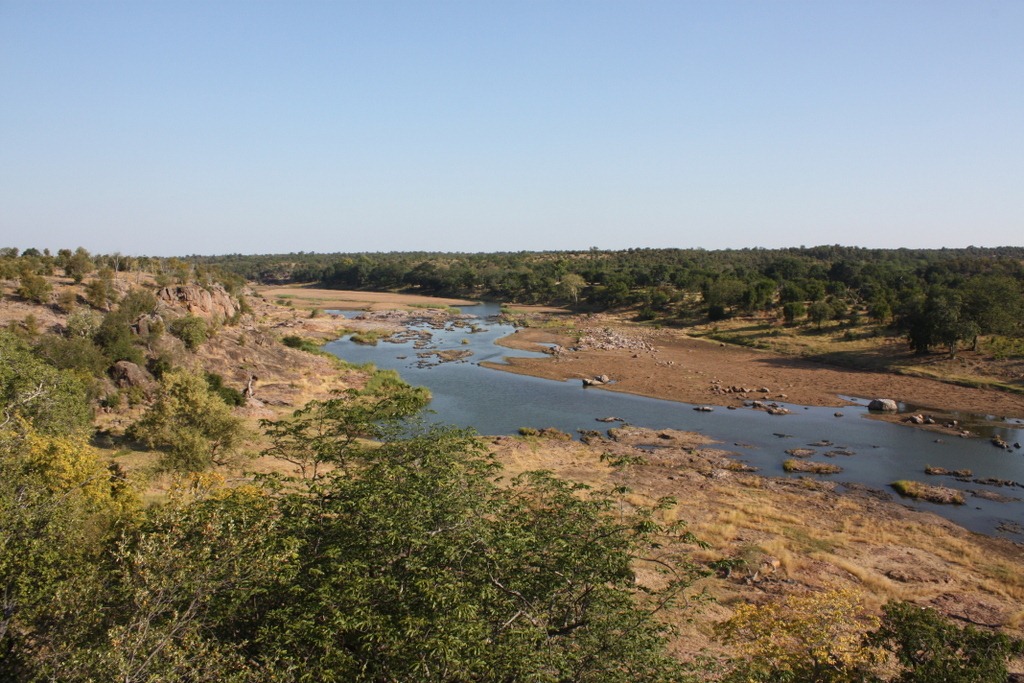
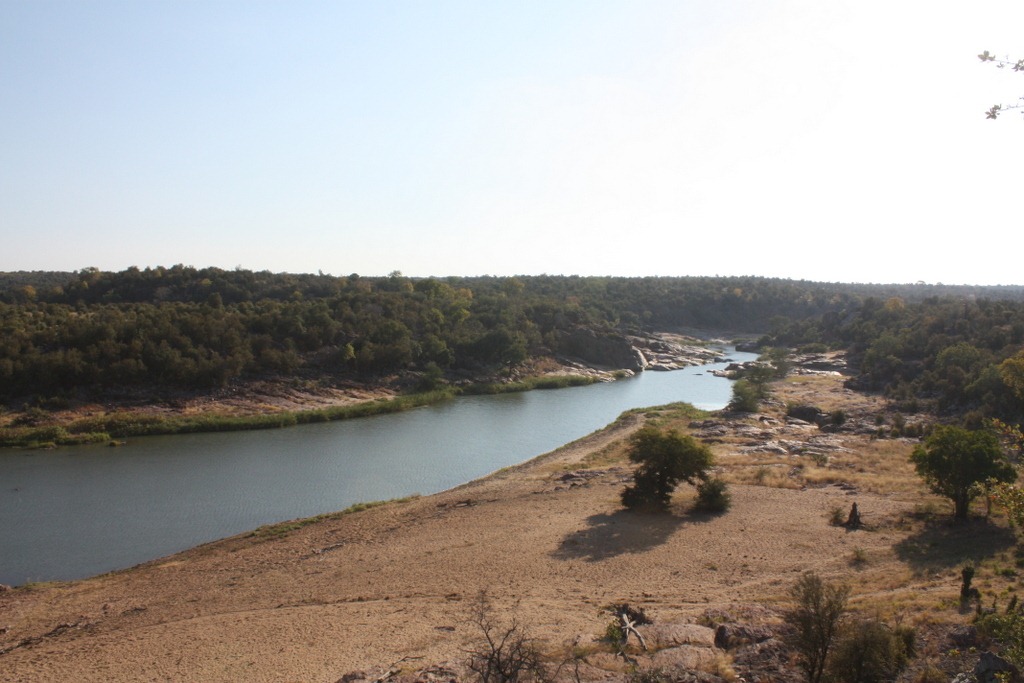
View from one of the lookout points
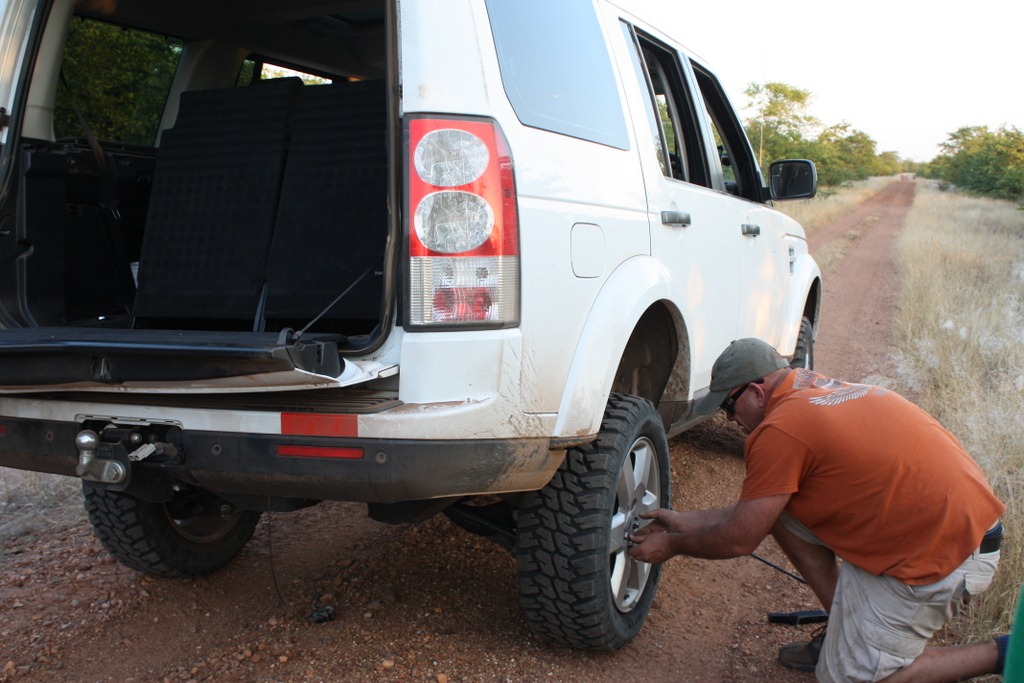
Damian’s form continued with him getting a puncture on his way back to camp.

Ask me no questions and I’ll tell you no lies
It was great to see that the general area was in good shape, with all the buildings and hides looking like they had recently been refurbished.
Day 4 29 April
We headed back out the park, destination Fishans Camp. The road along the railway line was better than I expected and we made it to the reception in good time, after a short traffic jam at the causeway.
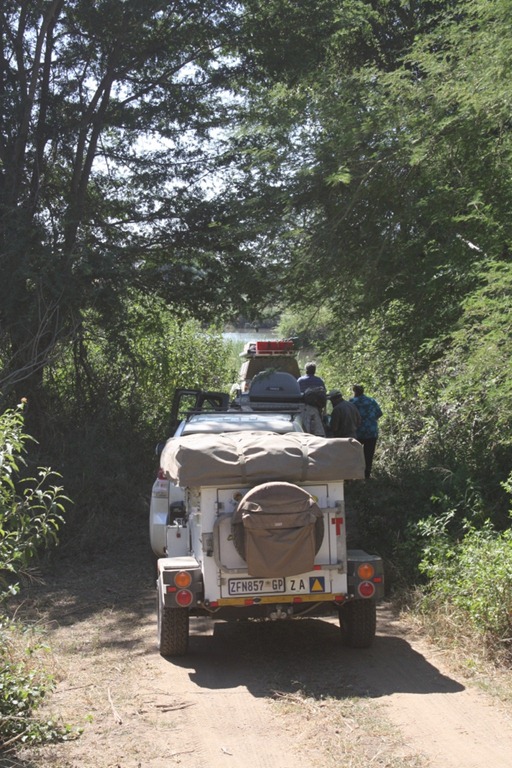
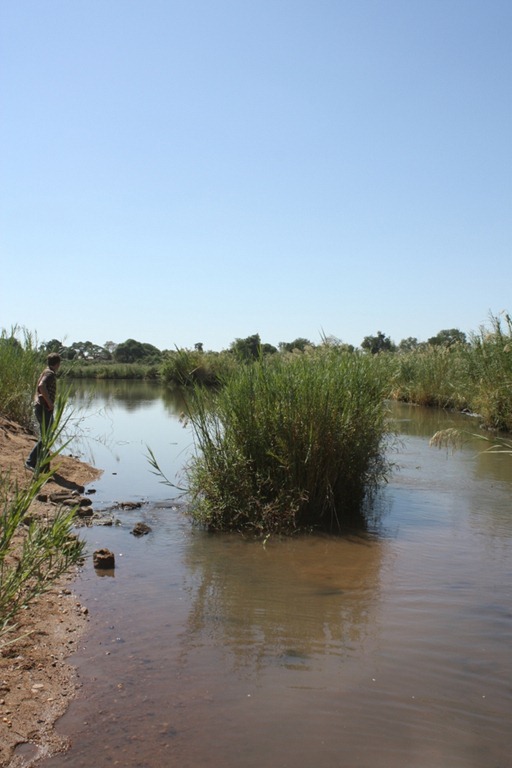
The water was very low and crossing was easy
We stopped for lunch at Chipinda Pools and then headed on to Fishan’s.

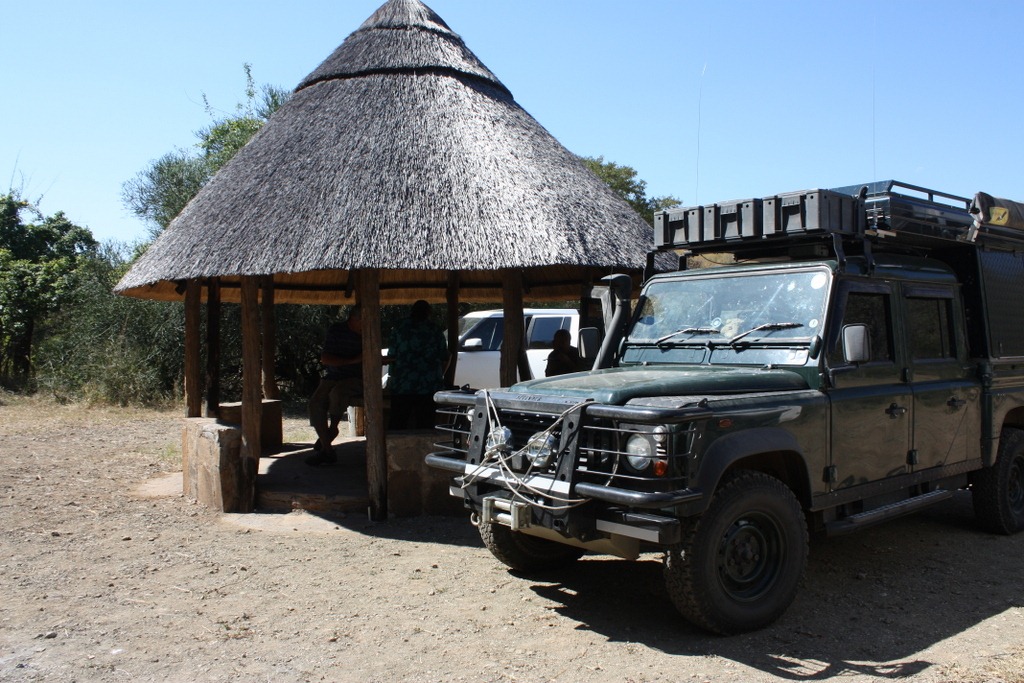
Damian got stuck coming out the river, and then Phillip had to recover me, after I got stuck pulling Damian out.

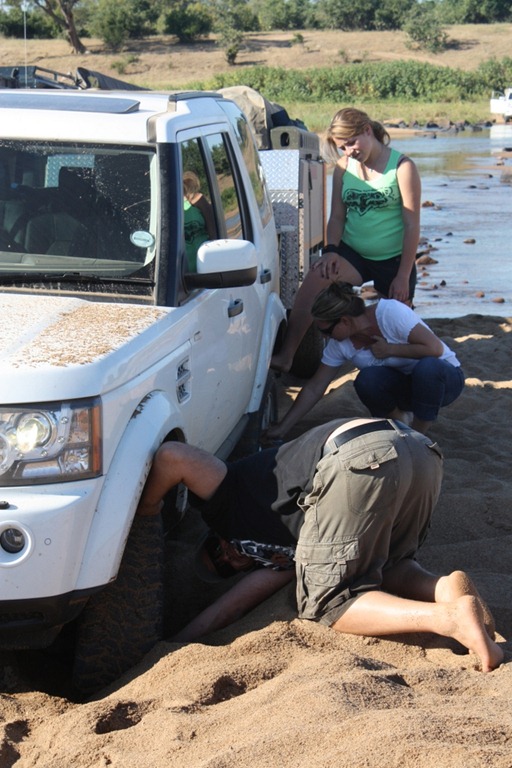
But it was nowhere as bad as Pafuri had been and 20 minutes later we where on our way again.
Upon arriving at the campsite, I wasn’t overly surprised to see someone already there. Another double booking! I’m beginning to suspect that this has become a unspoken policy of the Zimbabwe Parks Board.
Any way after introducing ourselves we went a bit further along and set up camp. Quite a different experience to our previous double booking in Hwange.
We had sun downers in the river bed and several beers to wash the dust away.
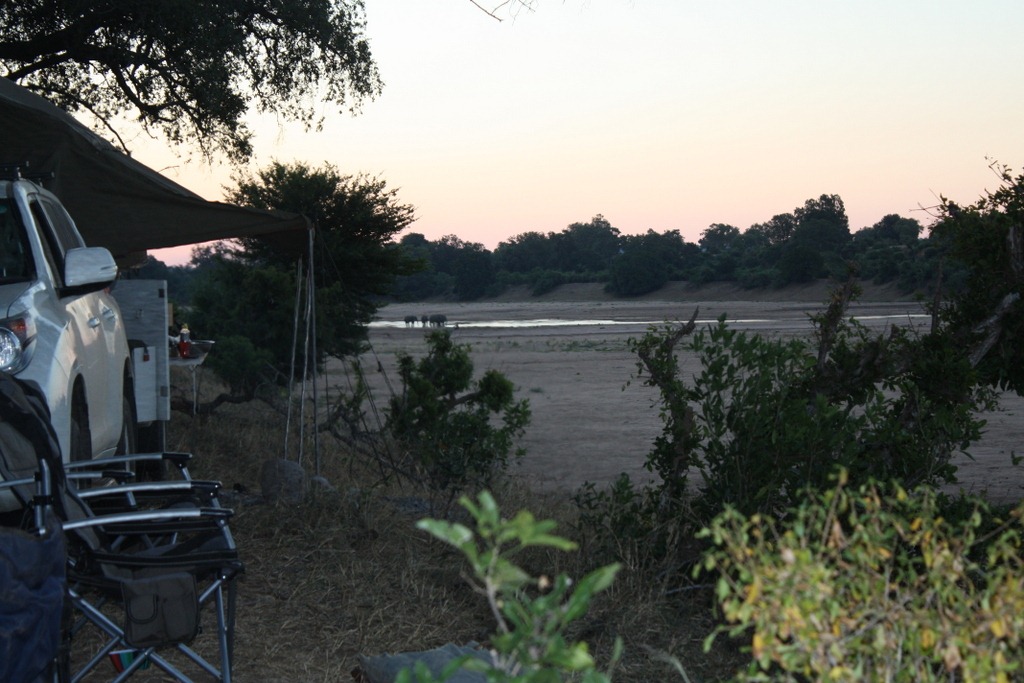
Ellies in the river
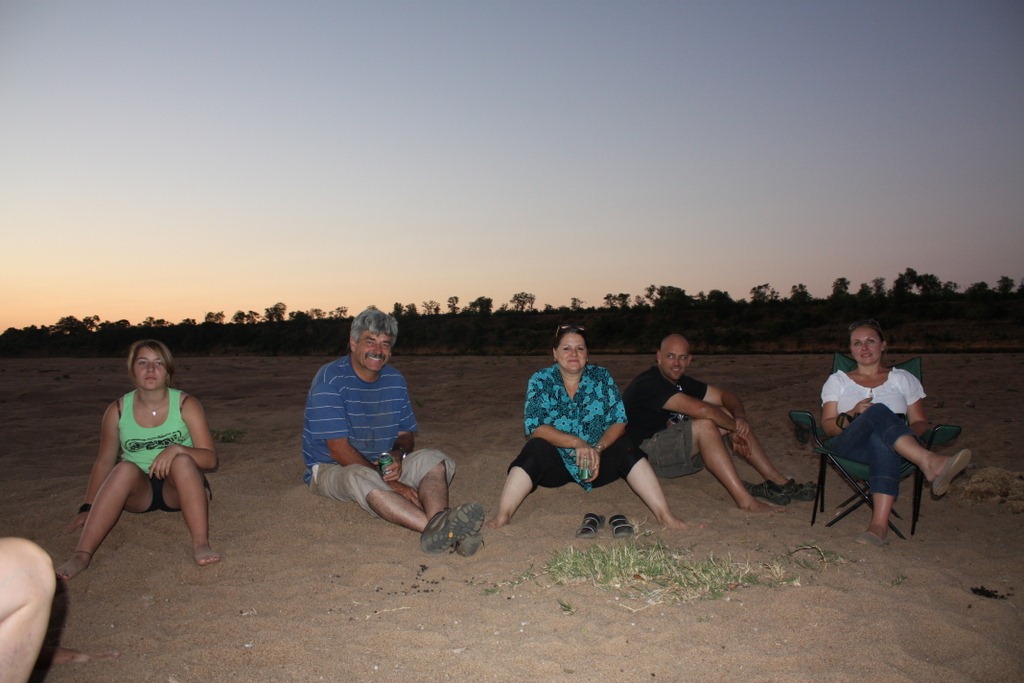

After supper we all had an early night
Day 5 30 April

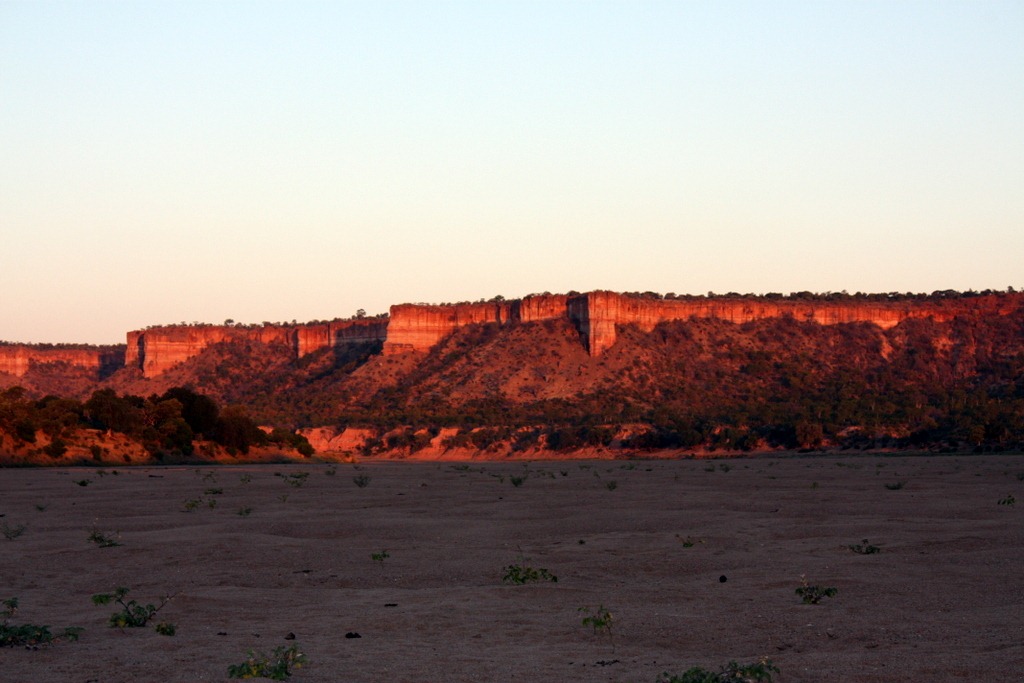
We had a lazy morning, and then headed in the direction of the Chilojo Cliffs to go look for Hennie Rautenbach’s geocache.
After much backwards and forwards. we eventually gave up, as all the roads became dead ends and headed to the cliff viewpoint for lunch.
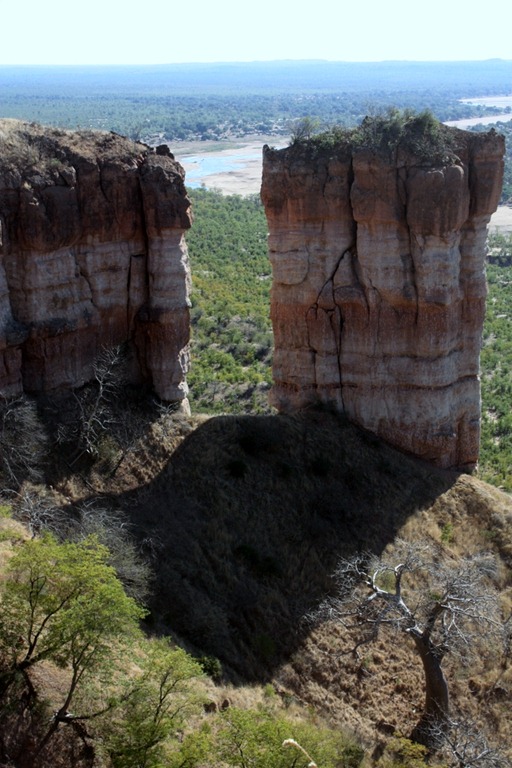
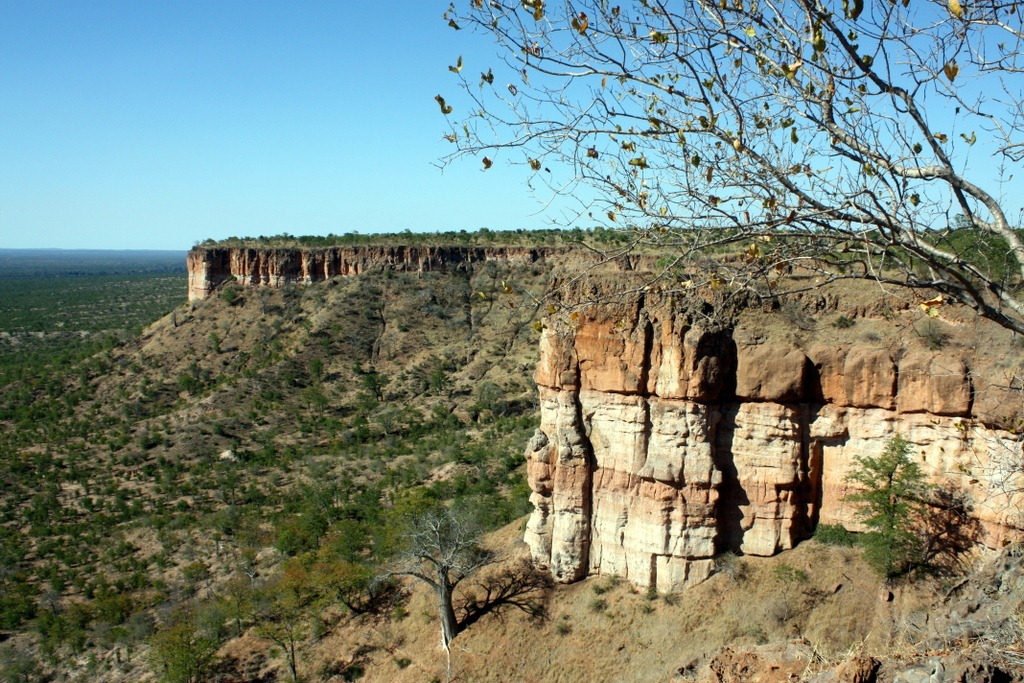

Nick developed a problem with his low/high range selector, with the car refusing to go into low range or select any of the other options. This was going to be an issue, as he needed low range to get back across the river.
I managed to get hold of Patrick Bremner on the sat phone and he in turn got hold of someone who worked for Toyota. After a couple more phone calls, Nick was told to check a sensor on the transfer case. The connector had come loose, so problem solved.
We had sun downers in the river again, accompanied by some ellies.
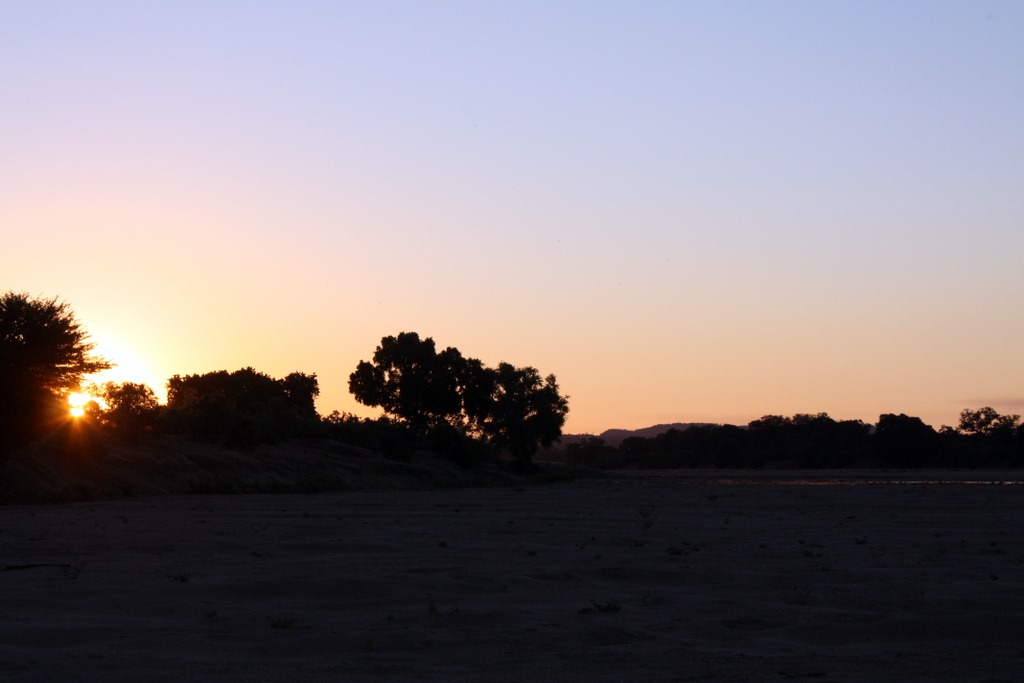
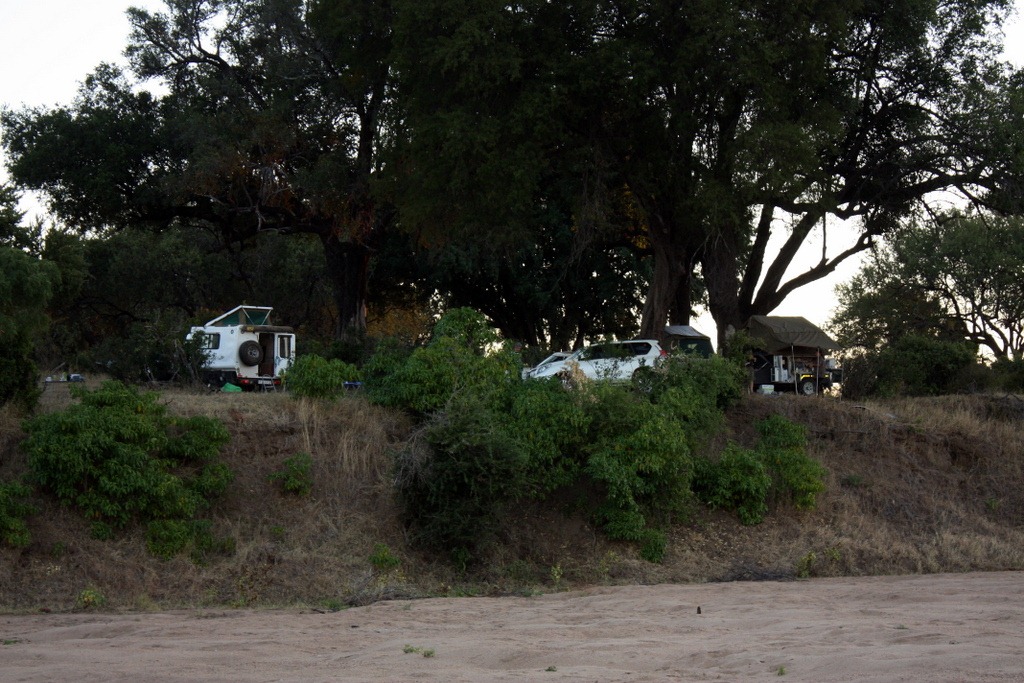
Not quite noticeable in this pic is the ellie that came out the river just to the right of Nick’s trailer
Day 6 1 May

We’d been hearing lions ever since we got into the park , but last night they were very close , with tracks in the river and also just behind our camp .
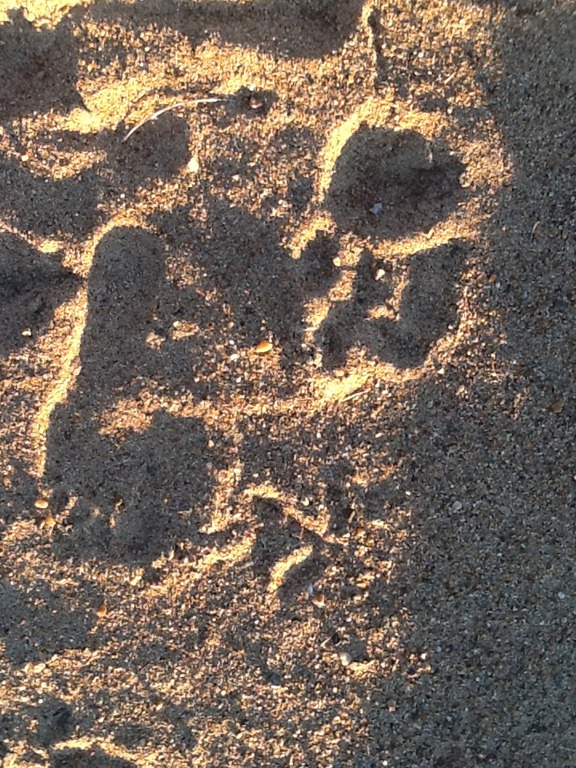
Dena’s footprint on the left , lion’s on the right
After breakfast we started home , via the back way out the park. Although this meant we had about a 150 km of dirt roads , we didn’t pass through any road blocks .
Damian and I however were both fine $20 for doing 88 km in a 60 km zone , although there were no signs to back this up. I wasn’t going to waste time over $20 though .
When we arrived at Beit Bridge , I was initially relived because there weren’t many cars in evidence. Unfortunately there were many locals queuing to get back into SA after the long weekend , and the waiting time was running at about 4 hours according to some people in the queue .
We decided to pay for runners and cleared the Zim side in about 20 min . It cost us R800 per car , but I felt it was worth it (it might have been less, but I made a rookie mistake when I paid for the first part of the process and I had left all my rands in my wallet. I’m pretty sure that drove the price up for the next stages)
We stopped off at the Spur in Messina for supper , and Phillip and I decided to stay over , while Nick and Damian drove home .
We headed to Boabab Caravan Park were I had stayed before , but they have done away with camping , so we had to book a chalet instead. Not great , but not bad for R330 for two people.
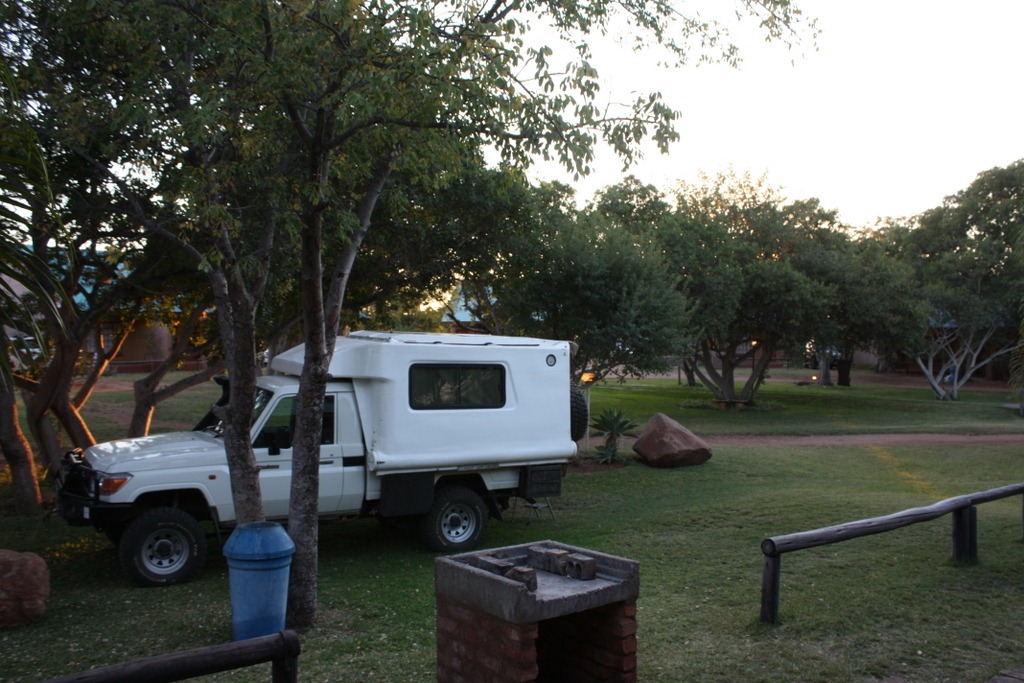
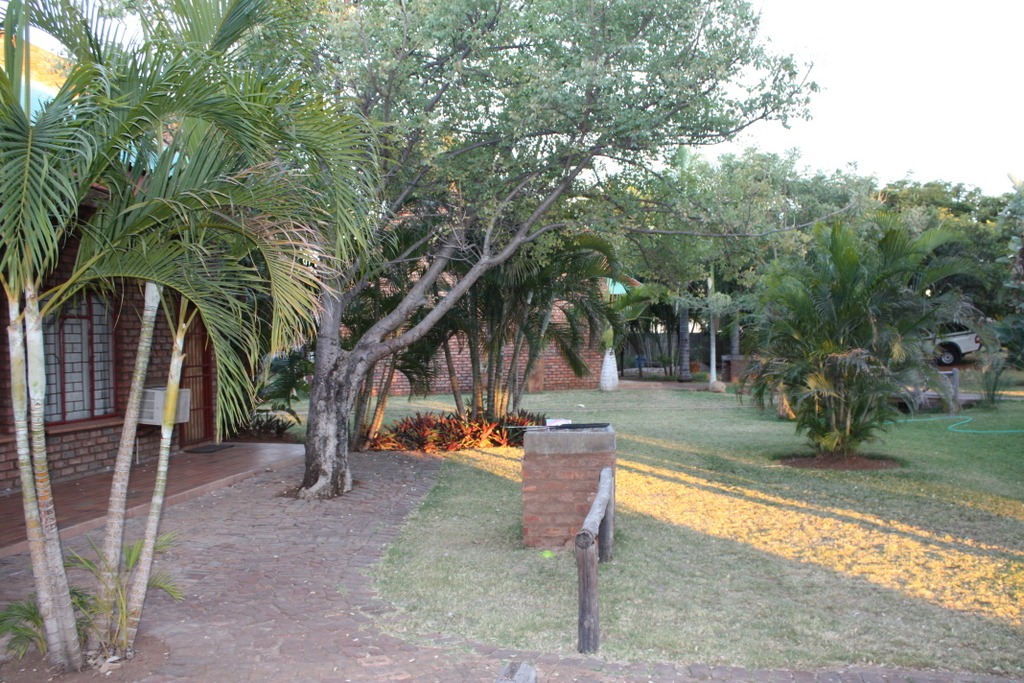
Day 7 2 May
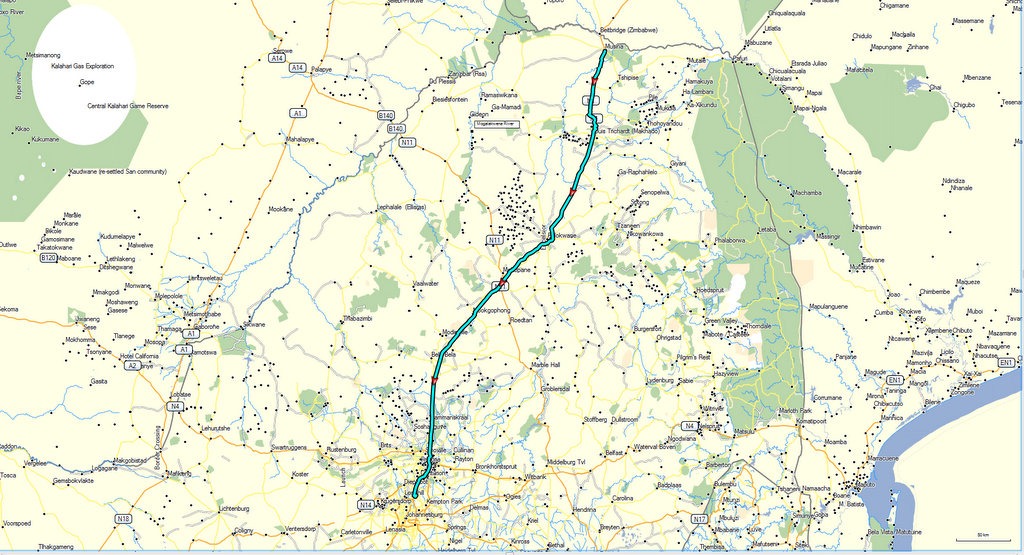
We left at about 6.30 and where home at about 12.30
In Conclusion
It’s been about 8 years since I was last in Gonarezhou , and it is definitely somewhere I will be visiting more often from now on. It is apparent that corruption is more common in the Southern parts of Zimbabwe , as I’ve never had any of the issues we experienced , when crossing the border higher up .
As far as Bo goes , I am over the moon with the performance and handling of the car itself , and the camper setup also makes it very easy to camp almost anywhere if required , and our set up time was around 5 minutes from stopping .

Interesting point of view Affirmative Action:
“South Africa is the only country in the world where affirmative action is in the favour of the majority who has complete political control. The fact that the political majority requires affirmative action (BEE) to protect them against a 9% minority group is testament to a complete failure on their part to build their own wealth making structures, such that their only solution is to take it from others.” Finally, a word recently coined to describe South Africa’s current political situation.
Ineptocracy (in-ep-toc’-ra-cy) –
a system of government where the least capable to lead are elected by the least capable of producing, and where the members of society least likely to sustain themselves or succeed, are rewarded with goods and services paid for by the confiscated wealth of a diminishing number of producers.
In urban areas, actually stopping – and we mean to a dead halt – at ‘stop streets’ is advisable, because the aforementioned creative cops have taken to positioning themselves out of sight around the junction, together with a plainclothes ‘spy’ at the stop sign itself, who lets them know the number of cars that do not in fact come to a full and uncontradictable halt. You then get nailed for twenty bucks.
Less creative and much more potentially fruitful in terms of road safety is the enforcement of the prohibition against using mobile ‘phones while driving. A court appearance is mandatory, and you can be fined up to US$5000 or more, and/or jailed for a minimum of two weeks, which is enough to spoil anyone’s holiday. Having been nearly rubbed out more often than I can remember by dilly dollies, weaving wallies and moronic maniacs with cellphones glued to their ears, I’m all in favour of this. However, hands-free kits appear to be OK.
Remember, too, that this will probably be applied to hand-held radios as well, so if you have one, don’t use it while driving. Ask your passenger to use it. And – as we’ve pointed out before – if it’s not licensed for use in Zimbabwe, you do risk being nailed for that as well.


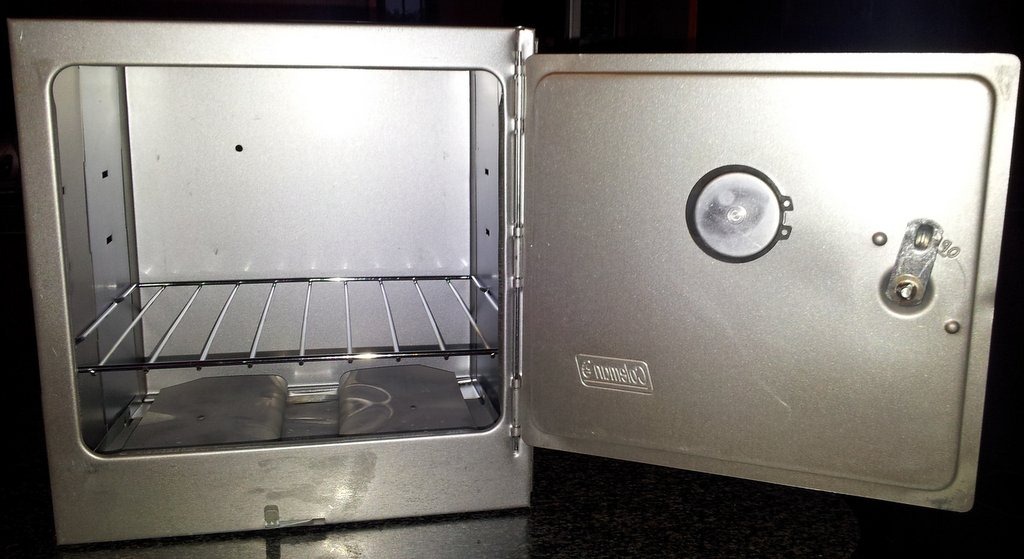

I ordered this from Takealot but found that my standard gas stove didn’t get it hot enough
So I bought this
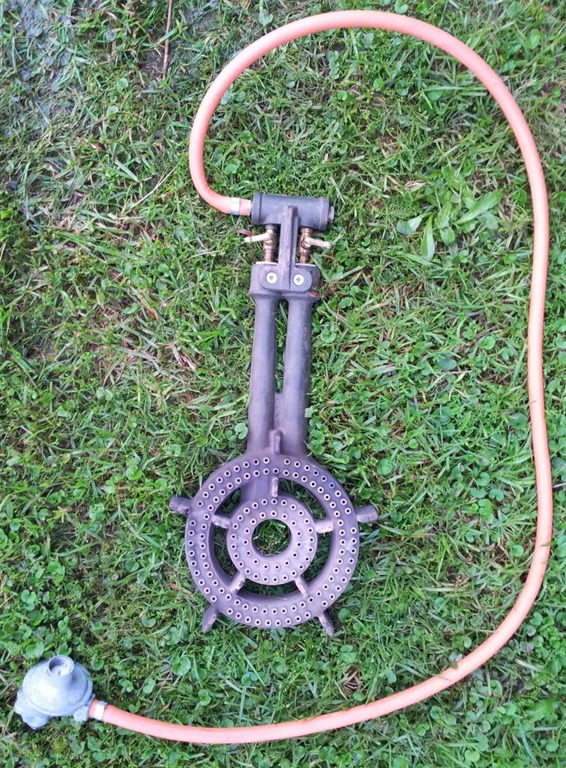

Problem solved

No. 30, February 2012
ABOUT THIS NEWSLETTER You’ve contacted us about ZIM4x4’s services, so we’re assuming you are interested in news about 4×4 travel in our area. Please contact us if you wish to be removed from our mailing list. Zimbabwe-SA connection problems continue, so if you have tried to contact us recently but have not received an answer, please resend on info and copy to dick.pitman, which is our new ‘fall-back’ address. You can also telephone or text us on (263-772) 324224.
ZIM4X4 BOOKINGS
We are delighted to say that we are now pretty well booked up for the 2012 season, from mid-April through to mid-November. We have one or two slots left in June and July, and at the end of November if anyone’s prepared to gamble on the weather, but otherwise: why not think long-term and consider a safari with us in 2013!
PARK FEES
Against all expectations, the Parks Authority has not increased its accommodation, camping and entry fees for 2012 – a very pleasant surprise in view of the fact that the Authority continues to be as cash-strapped as ever. Indeed, probably more so as other costs, such as salaries, vehicle maintenance &c continue to increase.
Protecting wild areas – and especially those holding ‘valuable wildlife’, such as elephants and rhinos – is an expensive business, which is why we at ZIM4x4 would have been neither surprised, nor unduly dismayed, if the Authority had imposed increases, provided of course that they were within reasonable bounds. Having both been a Parks officer, and also having worked in civilian wildlife conservation for many years, I have some idea of what these costs are.
It’s easy, for instance, to talk about the need to (for example) radiocollar certain species for research and conservation purposes. It becomes less easy when one knows that such exercises can cost at least US$1000 per animal, especially when sophisticated equipment such as aircraft and helicopters, expensive tranquillising drugs, and equally expensive radio equipment is required.
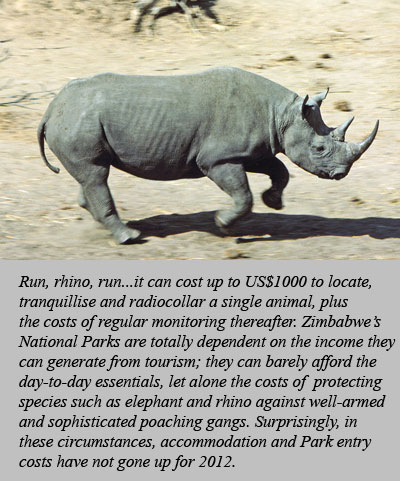
Road and track networks are also expensive to maintain. In many Parks, gravel and sand tracks need considerable work at the start of each dry season, and often require the use of graders and other heavy equipment.
Station vehicles lead hard lives, deploying labour gangs and ant-poaching patrols; and anti-poaching operations have constant needs for consumables such as radio batteries, as well as boots, uniforms, backpacks, bivvies, mosquito nets and much else besides.
“Yes, but” you may say – “even so, we’re not seeing much for our US$100-a-night campsite fee. The roads are appalling, the vehicles are falling apart, the toilets are delapidated and the only people we see doing research are NGOs.”
One must remember one or two harsh realities. Zimbabwe suffered ten years of economic disaster and a near-total absence of paying visitors to Parks. On top of this, from 2001 to the present day, the Parks Authority has not received a cent of official donor assistance, being a government department and therefore subject to both official and unofficial sanctions (and whatever anyone may say, the latter do exist, and hurt ‘ordinary’ Zimbabweans far more than they do the politicians they are supposed to affect).
NGOs – including our own favourite agency, The Zambezi Society – plug as many of the gaps as they can, and some significant sums of money are involved. But this is a drop in the bucket compared with the real needs, which include – for instance – at least one reasonably-paid and well-equipped ranger for every 20sq km of Park.
Field staff are, by and large, both dedicated and competent. You have to be, if – as they do – you are to risk your life against armed poaching gangs in return for around US$250 per month. But even they have their limits. Spare a thought for them, next time you are tempted to complain about the cost of a campsite or bundle of firewood. It’s a chicken-and-egg situation: facilities can’t be improved unless there’s money to pay for them; but hiking prices while facilities are substandard causes a furore. The resolution is, of course, a political matter.
Other Prices
Private-sector prices, on the other hand, are a different trolley of groceries. I think that every request we’ve made to private lodges, houseboats and other facilities has resulted in an increase over 2011 – up to 40% for some, and even 50% in one instance. We can understand this in some cases – houseboats, we suspect, have been something of a bargain for the last few years – but not in others. Ripping people off is a time-hallowed tradition in some sectors of the Zimbabwean tourism industry, and it definitely pays to shop around.
Change, of course, continues to be non-existent in many shops and supermarkets. Instead, you’ll be invited to take it in unwanted sweets, boxes of matches, or – in one recent personal case – in the form of a couple of 13-amp fuses (which, oddly, I did happen to need, so at least it was useful.
I suggest a counter-attack. carry your own bag of sweets, matches and what-have you and next time you get a supermarket bill for US$4.30 and no change available, give them US$4 and some sweets and see how they leap at it!
FUELS
A locally-produced ethanol blend recently began to appear at Zimbabwean service stations. Nothing new in that: we had it many years ago, before fuel injection became common, and it wrought a good deal of havoc with carburetters, fuel lines, seals and other items. Maybe that’s changed – we have to admit that being exclusively diesel jocks, our knowledge of petrol vehicles ended with the Land Rover Series II (and no, I won’t have a word said against it. It was the best go-anywhere, do-anything bush car I’ve ever owned. Just took a week to get there…!)
Such local consultations as we have made have been unproductive, apart from an abrupt intake of breath and some ominous head-shaking, and an intensive web search merely created massive confusion in our minds. Maybe some of our South African readers can shed some light for us, since ethanol appears to have been in use there for some time. Meanwhile, we’d suggest you give it a miss unless you are totally sure your vehicle can use the stuff without problems or damage.
THE RAINS
It hasn’t been the greatest of rainy seasons so far. The first rain fell very early, which is often an ominous sign, at least according to this particular self-appointed fundi. Thereafter, things more or less dried up until late December and early January. Even now, some weeks later, Mana Pools is reported to be ‘dry, with the grass already wilting’. Matusadona may be a bit better off, with average rainfall reported up to February 1st, and some heavy storms since.
At the time of writing, Zambezi flows at the Victoria Falls monitoring station are running at roughly 60% of last year’s figure on the same date. LakeKariba – having risen a little – is currently stable, at roughly 4m below ‘full supply height’. One floodgate was opened in January, but was closed again pretty smartly.
What does all this mean to intending visitors? Well, the first point – obviously – is that this rainy season still has some time to go, during which anything can happen, and quite probably will. Nevertheless, let’s look at some possible scenarios in the major wildlife Parks in our area:
OVERALL – poor rains mean that wildlife will gather early at remaining surface water sources, but that grazing will be exhausted well before the end of the dry season, resulting in wildlife deaths. Equally, good and late rains often mean that wildlife remains dispersed further into the dry season, young and old animals survive more easily, and numbers may increase.

In Matusadona, stable or falling lake levels would open lakeshore tracks for game-viewing. Also, the development of Panicum repens (Torpedo grass) fringes on exposed lakeshore areas may compensate for the loss of other grazing resources. Several Matusadona species, notably buffalo, zebra and waterbuck, historically show population increases during drought cycles.
In Mana Pools, the ‘floodplain’ areas are critical during the dry season, and although they are the scene of spectacular wildlife concentrations, there are no ameliorating factors in the event of poor rains. A good crop of A. albida pods – unlike 2011’s very poor crop – would help. Some would argue that reductions in species such as elephant, hippo and impala are desirable – even necessary – but it doesn’t make for enjoyable game-viewing.
To many visitors, the spectacular wildlife gatherings induced by drought can be superficially exciting, but it’s worth remembering that such gatherings are often created by food- or water-stress, and they should remember that they may well be looking at animals in poor condition (locating wildlife during and soon after the rains may need more work, but at least you’re usually seeing well-fed, sleek animals in good condition).
To many biologists, however, wildlife deaths induced by drought are a blessing in disguise in many areas, keeping numbers under control and reducing damage to habitats and ecosystems. Whatever the case, it’s worth remembering that both drought and abundance are natural phenomena, very longstanding features of the southern African climate, and – barringrapid and severe climate change – are likely to be so in the future. Calling them ‘good’ and ‘bad’ is a purely human trait.
Our own trip –
Sal and I made our own annual rainy-season pilgrimage to Mana Pools in mid-January, only to find there had been very little rain, there were some large bare areas, and such grass as had managed to get started was wilting rapidly. Nevertheless, wildlife still proved elusive. We spent a couple of days meandering around in the western part of the floodplain (incidentally, the unique features of this area are more correctly known as ‘alluvial terraces’ as they are not true floodplains) with little success.
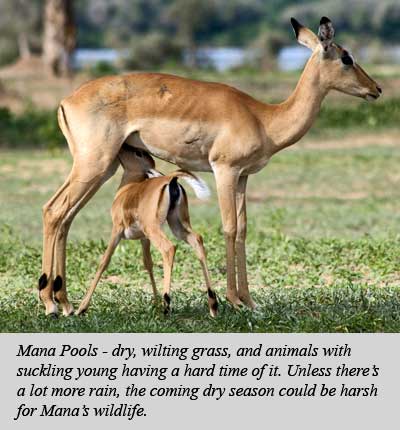
It was only when we turned our attention to the Mana Mouth and Nyamatusi areas that we began to see animals in any numbers. Here, however, we watched large elephant groups coming to the water every evening, and sighted a herd of buffalo we’d guess at 2-300 strong. We got the impression that there had been more rain in this part of the Park, resulting in better grass growth.
After a few days, however, we did get a couple of significant storms, whereupon the Mana Mouth elephants and buffalo vanished overnight and the place was virtually deserted. It probably hadn’t gone very far – probably south into the dense jesse that begins where the alluvial terraces end – but it’s not stuff you want to wander around in unless you absolutely have to, being thick as all hell and almost certainly stuffed with buffalo and elephant cows.
The warthogs and impala stayed put, however, and one of the delights was to see the large numbers of new-born young that are such a feature of the wet season. Another lay in the amazing concentrations of brilliantly-coloured butterflies that are also a feature of this time of year. A third was the crystal clarity of the air, the Zambian escarpment seemingly close enough to touch instead of lost in dry-season haze and smoke; the emerald-green new leaf against brilliant blue skies; and the deep purple of advancing storms, capped with towering cumulo-nimbus and spreading anvil canopies.
Journeys to our wildlife Parks during the rains are probably more suited to people who have already seen the animal concentrations in the dry season; if seeing such things is important, then ‘first-timers’ possibly run the risk of disappointment. For birders, on the other hand, it’s one of the best times of year, with most summer migrants present; and for ‘wilderness connoisseurs’ it’s maybe the best time of all. We didn’t see another vehicle during our entire 10-day stay at Mana. It was a true Garden of Eden. All it needed was a lot more rain….
TIPS FOR TRAVELLERS
Sally and I take many things for granted after spending 30-odd years largely in the ZambeziValley, but they seem to come as a huge surprise to some self-drive visitors.
There are, for instance, very few 220v – or any other – charging facilities in the Valley. The number of gadgets carried by travellers that can’t be charged via 12v vehicle lighter sockets seems to be increasing exponentially, while the availability of mains voltage facilities remains near zero except possibly in centres such as Kariba and Binga. Camera batteries seem to head the list, followed by mobile ‘phones (but see below!), torches, and other stuff.
Some Park offices will do it as a favour – if the generator has fuel – but you run the risk of some pretty dramatic voltage fluctuations. We thought we’d solved this problem by installing a small inverter in our vehicle, and running it off our second battery. However, our small laptop doesn’t like the inverter very much, probably because of its modified sine wave output, and the inverters available in Zimbabwe don’t seem to like the Zambezi Valley’s corrugated roads very much; we’ve gone through two already and a luta continua, so to speak. Any insights, anyone? Meanwhile we still feel the best advice we can give is to bring plenty of camera batteries, and switch your mobile ‘phone off – you’re in the bush, and there’s probably no network coverage anyway!
Another recent trend, mostly among our international clients, is a stubborn refusal to drink anything other than bottled water, even when perfectly drinkable water is available in campsites and lodges. If this is truly important to you,remember thatyou can’t buy bottled water except in urban centres. There aren’t any shops in our wildlife and wilderness areas. You’ll need to carry all you will need, and then some.
I have fairly strong views on this, one of them being that bottled water may have come from a borehole overlain by several hundred septic tanks, or even straight from an urban tap. I’d far rather drink pure Zambezi or Kariba water (boil it if you feel you need to), but I can’t formally recommend it in case someone gets a severe case of the runs and decides to sue me.
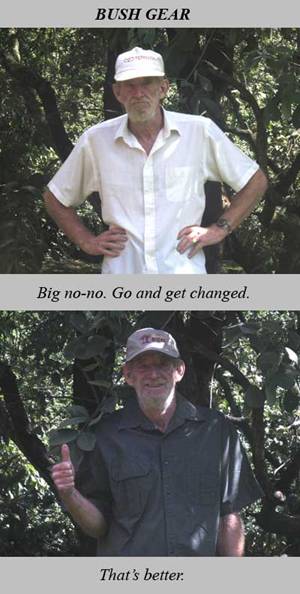
Gleaming white hats, shirts and trousers are a no-no – most wildlife will run a mile, especially if you are walking. Bring some subdued clothing – khakis, greys, jungle greens. Mere commonsense, you’d think? You’d be surprised at some of the sights we’ve seen…!
And most campsites are unfenced. Large specimens of local wildlife, such as elephants, buffalo, hippo and even lion, can wander through at will, and often do. You either love this, as Sal and I do; or hate it. We are acquainted with a not-very-bush-savvy couple who lasted one night at Mana, before fleeing back to Harare. The only reservation I have about these sites is they aren’t suitable if you have small children (which they didn’t). Otherwise – be calm; be sensible; and enjoy it.
More broadly: the low-lying Valley can be hot– hotter than you may have ever experienced. We had shade temperatures up to 48degC last October. Drink lots of water (bottled or otherwise). Bring electrolyte tabs – they really make a difference. It can also be cold – down to zero and below on some nights in May thru’ mid-August. And it can be wet anytime between September and May, even if only briefly. Plan accordingly.
It can be dusty. Leaky rear door seals are a major culprit, but keep all foodstuffs, bedding, clothes &c in dustproof containers and bags unless you want to go everywhere with the windows wound up. Be particularly aware of the need to protect cameras, binoculars and other sensitive items against dust.
And there are insects – mosquitoes during the rains, tsetse flies in some areas year-round. Most people do have an appreciation of malaria risks, and bring repellents, mosquito nets, long-sleeved shirts and long trousers for after-dark wear. For some reason, though, the appearance of a single tsetse fly within a vehicle can bring on near-hysteria.
Luckily, tsetse are generally confined to a few restricted areas, usually dense riverine or other bush. There isn’t actually a great deal to be done about them, as I think we’ve remarked before in these columns, except wind the windows up and turn on the air-conditioner.
Personally I loathe driving around like this (we never even possessed an air-conditioner for 27 of those 30 years, and only now because our current vehicle had one when we bought it). However, Sal’s twin remedies of a spray containing dilute Dettol, plus a fearsomely effective fly-swatter, work well. The only downside is getting whapped mercilessly on the back of my head, a landing pad favoured by tsetse flies for whatever reason, while trying to negotiate a tricky little gully or sandy riverbed.
There may be spiders in the bath; geckos on the walls; little sticky-frogs in the toilets; monkeys or baboons in your (rashly open) car and honey-badgers in the dustbins. None of these has to be a major disaster, as long as you are aware they may be there and manage your life accordingly.
To balance all this out, the ZambeziValley and LakeKariba areas are, quite simply, the loveliest places in the world. And the world is full of people who, having been there, can’t wait to come back. Drink from the Zambezi, etc etc, as per the strap at the end of our newsletter.
AND FINALLY –

The elephant doing the ‘tow start’ at left is just one of the famously placid old gentlemen who meander through Zambezi Valley campsites, shower your tent with pods, twigs and other debris from the Acacia albidas, and generally act as if they own the place. Which, of course, they do.
Should these animals wander out of the National Parks and into neighbouring hunting areas, they may – perfectly legitimately, as things stand – be shot by trophy hunters. This has already happened in more than one case. The individual at left hasn’t got particularly heavy tusks, so he might get away with it. However, the tusks on at least one of those at right are getting into the trophy ‘danger zone’.
Heavy ivory or not, these animals are outstanding characters, known and loved by Valley safari operators and visitors alike, and their loss would be a tragedy. One possible answer is to get them radiocollared and give legal protection to animals carrying such collars. This will be rather sad, as one more illusion of ‘wildness’ will be lost (not many people want to photograph radiocollared animals) but in the absence of other solutions, it’s better than losing them.


 Heine's Ramblings and Rumblings