Heine's Ramblings and Rumblings


Leave a comment

MEDIA RELEASE: SANRAL’S PLANS TO PROSECUTE eTOLL TRANSGRESSORS SEVERELY FLAWED

I though this was worth sharing


From: coms [mailto:coms@jp-sa.org] On Behalf Of Howard Dembovsky

Sent: 09 September 2013 02:15 PM
To: coms List Member
Subject: FW: MEDIA RELEASE: SANRAL’S PLANS TO PROSECUTE eTOLL TRANSGRESSORS SEVERELY FLAWED

Dear mailing list subscriber.

Please find below, a media release we have just sent out.

JPSA MEDIA STATEMENT – FOR IMMEDIATE RELEASE

TO: ALL NEWS, CRIME AND TRANSPORT EDITORS
DATE: MONDAY 9 SEPTEMBER 2013
SUBJECT: SANRAL’S PLANS TO PROSECUTE eTOLL TRANSGRESSORS SEVERELY FLAWED

JOHANNESBURG – The article which appeared in the Times Newspaper today wherein Vusi Mona has explained how SANRAL plans to “punish eToll rebels” has reference.

It is very interesting to note the revelations contained in this report and to see that SANRAL has again chosen to resort to levelling threats of criminal prosecution in an attempt to intimidate motorists into complying with their prepaid model of eToll collection.

Previously, SANRAL claimed that 600 000 eTags had been sold, but now it is claiming that 100 000 less than their previous claims have in fact been sold. This must raise the question as to just how accurate any of their claims, including but not limited to the monthly financial prejudice citizens will incur actually are. Additionally, this is the first time that they have come clean with the proportions of whom these eTags have been sold to, with an alleged 300 000 of them having been sold to private individuals – which we assume means individuals and companies which are not State institutions.

According to eNaTIS, there are 3 799 750 registered in Gauteng as at 30 June 2013. SANRAL claims that around 2 500 000 of these use Gauteng’s eToll freeways on a daily/monthly basis, and therefore it is safe to assume that more than 2 million vehicles do not have eTags at this stage. This represents 80% of the vehicles on the road in Johannesburg and Tshwane not having eTags.

It has been stated by Vusi Mona and others that the Criminal Procedure Act will be used to prosecute eToll “rebels” and this is entirely possible – even with AARTO in effect in Johannesburg and Tshwane, by simply classifying all eToll violations as criminal offences. What seems to have been overlooked however is the fact that the National Prosecuting Authority does not prosecute one million criminal matters in total over the course of a year; let alone double that each month.

If it is SANRAL’s intention to bring a grinding halt to the South African criminal justice system, they are most certainly going the right way about achieving this. Clearly they would like all prosecutions for serious crimes to be side-lined in favour of criminalising people who choose to oppose their unjust eToll laws.

It is very easy to say how they will deal with eToll “rebels” in an attempt to scare them, but it is not so easy to carry out these threats. SANRAL engaging in such behaviour is despicable and such actions are additionally completely contrary to the “Batho Pele” principle which is supposed to be rooted and promoted in any political and legislative framework.

ßENDSà

Best Regards,

Howard Dembovsky

National Chairman – Justice Project South Africa (NPC)

Association Not For Gain | Incorporated as a non-profit company under the Companies Act, 2008 | Registration Number 2010/019972/08
Tel: +27 (0) 12 753 6802 or +27 (0) 81 302 3694

Mobile: +27 (0) 82 418 6210

Fax: +27 (0) 86 647 3293

Website: www.jp-sa.org
Follow JPSA on Twitter
“Injustice anywhere is a threat to justice everywhere” – Martin Luther King
“All that is required for the triumph of evil is that good men and women do nothing ” – Edmund Burke
JPSA Head Office: Ground Floor, 500 Kyalami Boulevard, Kyalami Office Park, Kyalami, Midrand, 1684 –


Email Disclaimer: http://www.jp-sa.org/EmailDisclaimer.asp


Leave a comment

Long Long Ago


a


Leave a comment

Photobum err bomb

I have finally gotten around to starting my Mabua trip report and came across this. Take a bow Mike Cliff

20130813_201543


1 Comment

Take that Shrub Huggers

 Where Does the Carbon Dioxide Really Come From?
 Professor Ian Plimer could not have said it better!
 If you’ve read his book you will agree, this is a good summary.

PLIMER: “Okay, here’s the bombshell. The volcanic eruption in Iceland . Since its first spewing of volcanic ash has, in just FOUR DAYS, NEGATED EVERY SINGLE EFFORT you have made in the past five years to control CO2 emissions on our planet – all of you.
Of course, you know about this evil carbon dioxide that we are trying to suppress – it’s that vital chemical compound that every plant requires to live and grow and to synthesize into oxygen for us humans and all animal life. I know….it’s very disheartening to realize that all of the carbon emission savings you have accomplished while suffering the inconvenience and expense of driving Prius hybrids, buying fabric grocery bags, sitting up till midnight to finish your kids “The Green Revolution” science project, throwing out all of your non-green cleaning supplies, using only two squares of toilet paper, putting a brick in your toilet tank reservoir, selling your SUV and speedboat, vacationing at home instead of abroad, nearly getting hit every day on your bicycle, replacing all of your 50 cent light bulbs with $10.00 light bulbs…..well, all of those things you have done have all gone down the tubes in just four days.

The volcanic ash emitted into the Earth’s atmosphere in just four days – yes, FOUR DAYS – by that volcano in Iceland has totally erased every single effort you have made to reduce the evil beast, carbon. And there are around 200 active volcanoes on the planet spewing out this crud at any one time – EVERY DAY.

I don’t really want to rain on your parade too much, but I should mention that when the volcano Mt Pinatubo erupted in the Philippines in 1991, it spewed out more greenhouse gases into the atmosphere than the entire human race had emitted in all its millions of years on earth.
Yes, folks, Mt Pinatubo was active for over One year – think about it.

Of course, I shouldn’t spoil this ‘touchy-feely tree-hugging’ moment and mention the effect of solar and cosmic activity and the well-recognized 800-year global heating and cooling cycle, which keeps happening despite our completely insignificant efforts to affect climate change.

And I do wish I had a silver lining to this volcanic ash cloud, but the fact of the matter is that the bush fire season across the western USA and Australia this year alone will negate your efforts to reduce carbon in our world for the next two to three years. And it happens every year.
Just remember that your government just tried to impose a whopping carbon tax on you, on the basis of the bogus ‘human-caused’ climate-change scenario.

Hey, isn’t it interesting how they don’t mention ‘Global Warming’ anymore, but just ‘Climate Change’ – you know why?
It’s because the planet has COOLED by 0.7 degrees in the past century and these global warming propaganda artists got caught in a lie.

And, just keep in mind that you might yet have an Emissions Trading Scheme – that whopping new tax – imposed on you that will achieve absolutely nothing except make you poorer – and, it won’t stop any volcanoes from erupting, that’s for sure.

But, hey, relax……give the world a hug and have a nice day!”

Ian Rutherford Plimer is an Australian geologist, professor emeritus of Earth Sciences at the University of Melbourne , professor of mining geology at the University of Adelaide , and the director of multiple mineral exploration and mining companies. He has published 130 scientific papers, six books and edited the Encyclopedia of Geology.

Born 12 February 1946 (age 67)
Residence Australia
Nationality Australian
Fields Earth ScienceGeology,Mining Engineering
Institutions University of New England,University of Newcastle,University of Melbourne,University of Adelaide
Alma mater University of New South Wales,Macquarie University
Thesis The pipe deposits of tungsten-molybdenum-bismuth in eastern Australia (1976)
Notable awards Eureka Prize (1995, 2002),Centenary Medal (2003), Clarke Medal (2004)


Leave a comment

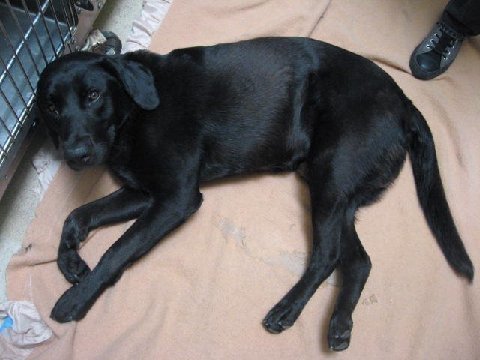
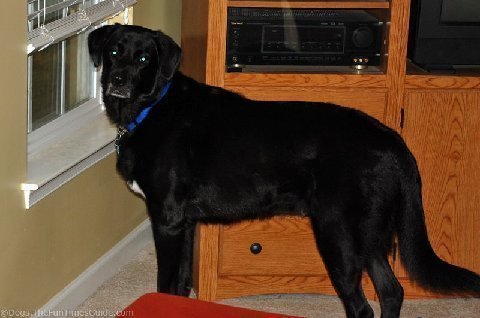
Reggie – A Black Lab

They told me the big black Lab’s name was Reggie,

as I looked at him lying in his pen.

The shelter was clean, no-kill,

and the people really friendly.

I’d only been in the area for six months, but

everywhere I went in the small college town, people

we’re welcoming and open. Everyone waves

when you pass them on the street.

But something was still missing as I attempted to settle

in to my new life here, and I thought a dog couldn’t hurt.

Give me someone to talk to. And I had just seen

Reggie’s advertisement on the local news. The shelter

said they had received numerous calls right after,

but they said the people who had come down

to see him just didn’t look like “Lab people,”

whatever that meant. They must’ve thought I did.

But at first, I thought the shelter had misjudged me

in giving me Reggie and his things, which consisted

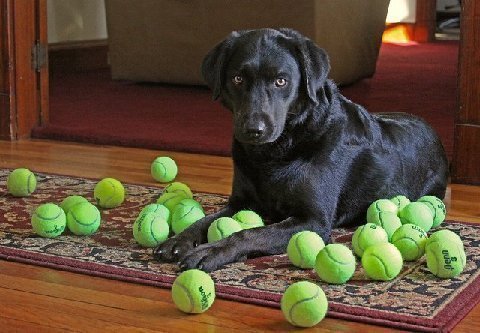
of a dog pad, bag of toys almost all of which were

brand new tennis balls, his dishes and

a sealed letter from his previous owner.

See, Reggie and I didn’t really hit it off when we got home.

We struggled for two weeks (which is how long the shelter

told me to give him to adjust to his new home). Maybe it

was the fact that I was trying to adjust, too.

Maybe we were too much alike.

I saw the sealed envelope. I had completely forgotten

about that. “Okay, Reggie,” I said out loud, “let’s see

if your previous owner has any advice.”

_____________________

To Whomever Gets My Dog:

Well, I can’t say that I’m happy you’re reading this,

a letter I told the shelter could only be opened by

Reggie’s new owner. I’m not even happy writing it.

He knew something was different.

So let me tell you about my Lab in the hopes

that it will help you bond with him and he with you.

First, he loves tennis balls. The more the merrier.

Sometimes I think he’s part squirrel, the way he hoards them.

He usually always has two in his mouth, and he tries to get

a third in there. Hasn’t done it yet. Doesn’t matter where

you throw them, he’ll bound after them, so be careful.

Don’t do it by any roads.

Next, commands. Reggie knows the

obvious ones —“sit,” “stay,” “come,” “heel.”

He knows hand signals, too: He knows “ball”

and “food” and “bone” and “treat” like nobody’s business.

Feeding schedule: twice a day, regular

store-bought stuff; the she lter has the brand.

He’s up on his shots. Be forewarned: Reggie hates the vet.

Good luck getting him in the car. I don’t know how he

knows when it’s time to go to the vet, but he knows.

Finally, give him some time. It’s only been Reggie and

me for his whole life. He’s gone everywhere with me,

so please include him on your daily car rides if you can.

He sits well in the backseat, and he doesn’t bark

or complain. He just loves to be around people,

and me most especially.

And that’s why I need to share one more bit of info with you…

His name’s not Reggie. He’s a smart dog, he’ll get used to it

and will respond to it, of that I have no doubt. But I just couldn’t

bear to give them his real name. But if someone is reading this …

well it means that his new owner should know his real name.

His real name is “Tank.” Because, that is what I drive.

I told the shelter that they couldn’t make “Reggie” available

for adoption until they received word from my company commander.

You see, my parents are gone, I have no siblings, no one I could’ve

left Tank with … and it was my only real request of the Army upon my deployment to Iraq, that they make one phone call to the shelter …

in the “event” … to tell them that Tank could be put up for adoption.

Luckily, my CO is a dog-guy, too, and he knew where my platoon

was headed. He said he’d do it personally. And if you’re reading this,

then he made good on his word.

Tank has been my family for the last six years, almost as long

as the Army has been my family. And now I hope and pray that

you make him part of your family, too, and that he will adjust

and come to love you the same way he loved me.

If I have to give up Tank to keep those terrible people from coming

to the US I am glad to have done so. He is my example of service and

of love. I hope I honored him by my service to my country and comrades.

All right, that’s enough. I deploy this evening and have to drop this letter

off at the shelter. Maybe I’ll peek in on him and see if he finally got

that third tennis ball in his mouth.

Good luck with Tank. Give him a good home, and

give him an extra kiss goodnight – every night – from me.

Thank you,

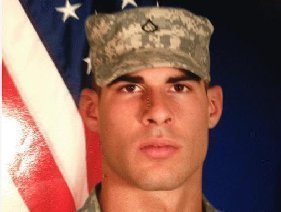
Paul Mallory

_____________________

I folded the letter and slipped it back in the envelope. Sure,

I had heard of Paul Mallory, everyone in town knew him,

even new people like me. Local kid, killed in Iraq a few

months ago and posthumously earning the Silver Star

when he gave his life to save three buddies.

Flags had been at half-mast all summer.

I leaned forward in my chair and rested my

elbows on my knees, staring at the dog.

“Hey, Tank,” I said quietly.

The dog’s head whipped up, his ears

cocked and his eyes bright.

“C’mere boy.”

He was instantly on his feet, his nails clicking on the hardwood floor.

He sat in front of me, his head tilted, searching for the name

he hadn’t heard in months. “Tank,” I whispered.

His tail swished.

I kept whispering his name, over and over, and each time,

his ears lowered, his eyes softened, and his posture relaxed

as a wave of contentment just seemed to flood him. I stroked

his ears, rubbed his shoulders, buried my face into

his scruff and hugged him.

“It’s me now, Tank, just you and me. Your old pal gave you to me.”

Tank reached up and licked my cheek.

“So whatdaya say we play some ball?”

His ears perked again.

“Yeah? Ball? You like that? Ball?”

Tank tore from my hands and disappeared into the next room.

And when he came back, he had three tennis balls in his mouth.

If you can read this without getting a lump in your

throat or a tear in your eye, you just ain’t right.


3 Comments

Mash spotted !!!!

Came roaring past me on the N1 the other day . Must admit I felt very nostalgic .


20130114_120358-001


Leave a comment

Bye Bye Blackbird

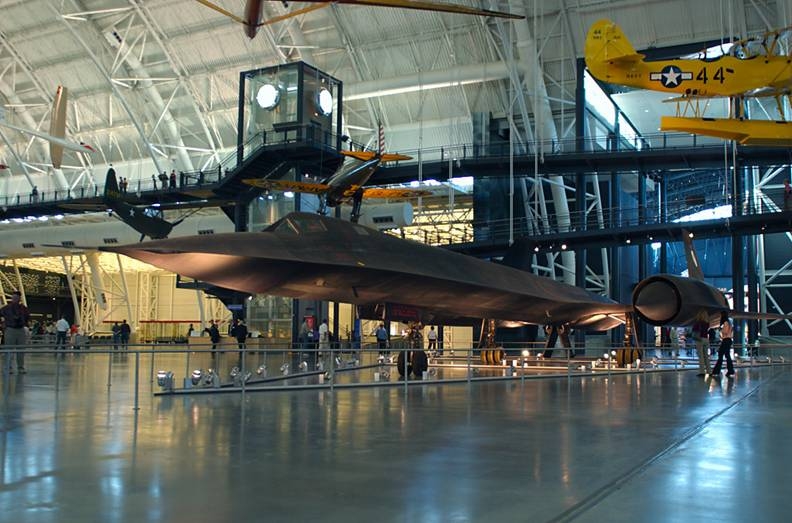
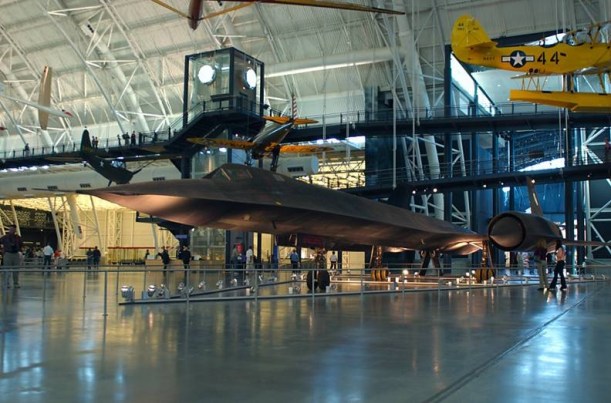
BYE BYE SR-71 BLACKBIRD

FROM AN SR-71 PILOT…….Very interesting read….

In April 1986, following an attack on American
soldiers in a Berlin disco, President Reagan
ordered the bombing of Muammar Qaddafi’s
terrorist camps in Libya.

My duty was to fly over Libya, and take
photographs recording the damage our

F-111’s had inflicted.

Qaddafi had established a ‘line of death,’
a territorial marking across the Gulf of Sidra,
swearing to shoot down any intruder, that

Crossed the boundary.

On the morning of April 15, I rocketed past

the line at 2,125 mph.
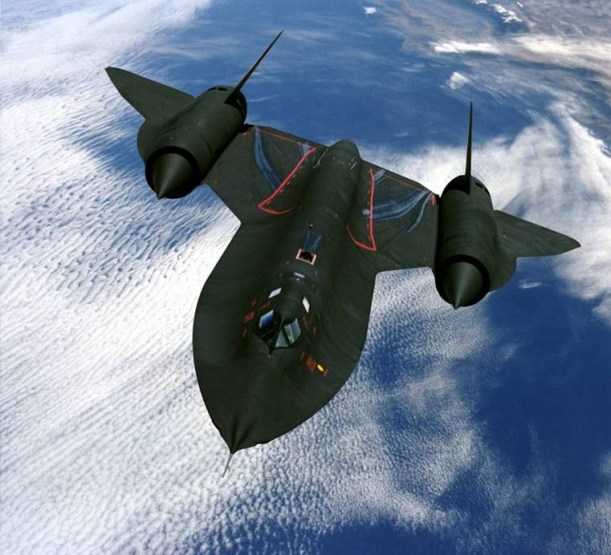
I was piloting the SR-71 spy plane, the world’s
fastest jet, accompanied by a Marine Major (Walt),
the aircraft’s reconnaissance systems officer (RSO).

We had crossed into Libya , and were approaching
our final turn over the bleak desert landscape, when
Walt informed me, that he was receiving missile
launch signals.

I quickly increased our speed, calculating the time
it would take for the weapons, most likely SA-2 and

SA-4 surface-to-air missiles, capable of Mach 5, to

Reach our altitude.


I estimated, that we could beat the rocket-powered
missiles to the turn, and stayed our course, betting
our lives on the plane’s performance.
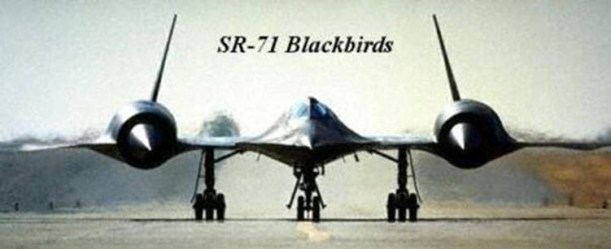
After several agonizingly long seconds, we made
the turn and blasted toward the Mediterranean.

‘You might want to pull it back,’ Walt suggested.
It was then that I noticed I still had the throttles
full forward.

The plane was flying a mile every 1.6 seconds,

well above our Mach 3.2 limit.

It was the fastest we would ever fly.

I pulled the throttles to idle, just south of Sicily ,
but we still overran the refueling tanker, awaiting

us over Gibraltar.

Scores of significant aircraft have been produced,
in the 100 years of flight, following the achievements
of the Wright brothers, which we celebrate in
December.

Aircraft such as the Boeing 707, the F-86 Sabre Jet,
and the P-51 Mustang, are among the important

machines that have flown our skies.

But the SR-71, also known as the Blackbird, stands alone
as a significant contributor to Cold War victory, and as the
fastest plane ever, and only 93 Air Force pilots ever steered
the ‘sled,’ as we called our aircraft.
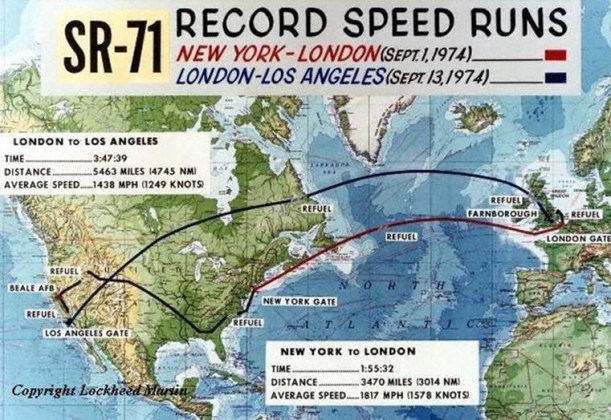
The SR-71, was the brainchild of Kelly Johnson,
the famed Lockheed designer, who created the
P-38, the F-104 Starfighter, and the U-2.

After the Soviets shot down Gary Powers U-2 in 1960,
Johnson began to develop an aircraft, that would
fly three miles higher, and five times faster, than
the spy plane, and still be capable of photographing
your license plate.

However, flying at 2,000 mph would create intense heat
on the aircraft’s skin.


Lockheed engineers used a titanium alloy, to construct
more than 90 percent of the SR-71, creating special tools,
and manufacturing procedures to hand-build each of the
(40 planes… Wow!!! 40 planes???? I thought only 7.)
Special heat-resistant fuel, oil, and hydraulic fluids, that
would function at 85,000 feet, and higher, also had to be
developed.
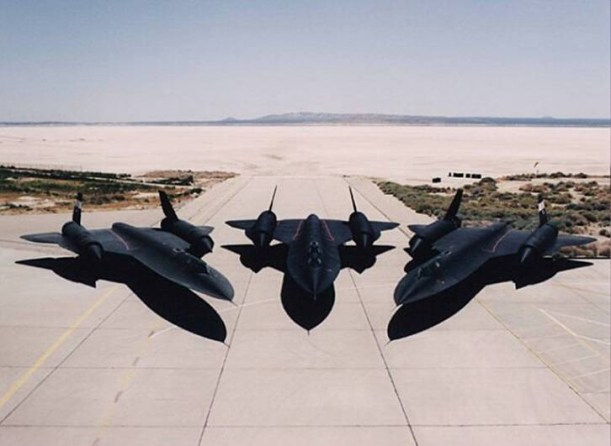
In 1962, the first Blackbird successfully flew, and
in 1966, the same year I graduated from high school,
the Air Force began flying operational SR-71 missions.

I came to the program in 1983, with a sterling record
and a recommendation from my commander,
completing the weeklong interview, and meeting
Walt, my partner for the next four years.

He would ride four feet behind me, working all the
cameras, radios, and electronic jamming equipment.

I joked, that if we were ever captured, he was the spy,
and I was just the driver.

He told me to keep the pointy end forward.

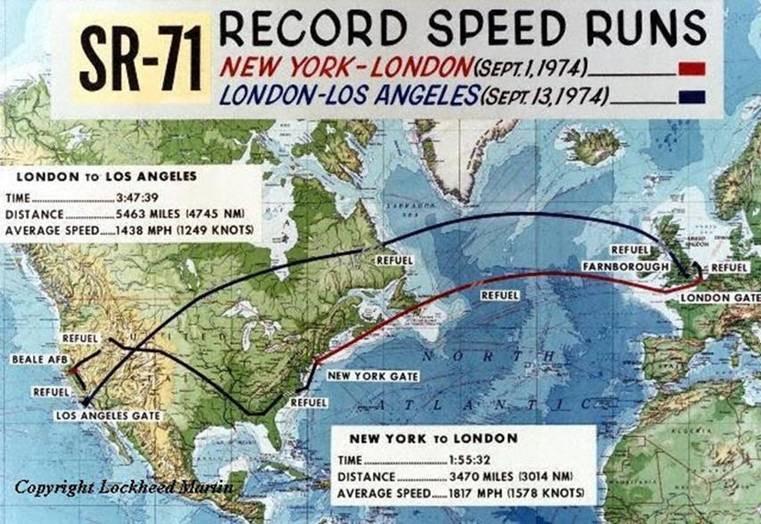
We trained for a year, flying out of Beale AFB in
California, Kadena Airbase in Okinawa, and RAF
Mildenhall in England.

On a typical training mission, we would take off near
Sacramento, refuel over Nevada, accelerate into Montana,
obtain a high Mach speed over Colorado, turn right over
New Mexico, speed across the Los Angeles Basin, run up
the West Coast, turn right at Seattle, then return to Beale.

Total flight time: – Two Hours and Forty Minutes.

One day, high above Arizona, we were monitoring
the radio traffic of all the mortal airplanes below us.
First, a Cessna pilot asked the air traffic controllers
to check his ground speed. ‘Ninety knots,’ ATC replied.
A Bonanza soon made the same request.
‘One-twenty on the ground,’ was the reply.

To our surprise, a navy F-18 came over the radio, with a
ground speed check.

I knew exactly what he was doing.

Of course, he had a ground speed indicator in his cockpit,
but he wanted to let all the bug-smashers in the valley,
know what real speed was, ‘Dusty 52, we show you at 620
on the ground,’ ATC responded.

The situation was too ripe.

I heard the click of Walt’s mike button in the rear seat.
In his most innocent voice, Walt startled the controller
by asking for a ground speed check from 81,000 feet,
clearly above controlled airspace.


In a cool, professional voice, the controller replied,
‘Aspen 20, I show you at 1,982 knots on the ground.’
We did not hear another transmission on that
frequency, all the way to the coast.

< N>

The Blackbird always showed us something new,
each aircraft possessing its own unique personality.

In time, we realized we were flying a national treasure.

When we taxied out of our revetments for take-off,
people took notice.

Traffic congregated near the airfield fences, because
everyone wanted to see, and hear the mighty SR-71.

You could not be a part of this program, and not come
to love the airplane.

Slowly, she revealed her secrets to us, as we earned
her trust.

One moonless night, while flying a routine training
mission over the Pacific, I wondered what the sky
would look like from 84,000 feet, if the cockpit lighting
were dark.

While heading home on a straight course, I slowly turned
down all of the lighting, reducing the glare and revealing
the night sky.

Within seconds, I turned the lights back up, fearful that

the jet would know, and somehow punish me.

But my desire to see the sky, overruled my caution,
I dimmed the lighting again.

To my amazement, I saw a bright light outside
my window.

As my eyes adjusted to the view, I realized that the
brilliance was the broad expanse of the Milky Way,
now a gleaming stripe across the sky.

Where dark spaces in the sky had usually existed,
there were now dense clusters of sparkling stars.

Shooting Stars, flashed across the canvas every
few seconds.

It was like a fireworks display with no sound.

I knew I had to get my eyes back on the instruments,
and reluctantly, I brought my attention back inside.

To my surprise, with the cockpit lighting still off,
I could see every gauge, lit by starlight.

In the plane’s mirrors, I could see the eerie shine of
my gold spacesuit, incandescently illuminated, in a
celestial glow.

I stole one last glance out the window.
Despite our speed, we seemed still before the
heavens, humbled in the radiance of a much greater
power.

For those few moments, I felt a part of something far
more significant, than anything we were doing in the plane.

The sharp sound of Walt’s voice on the radio, brought me
back to the tasks at hand, as I prepared for our descent.
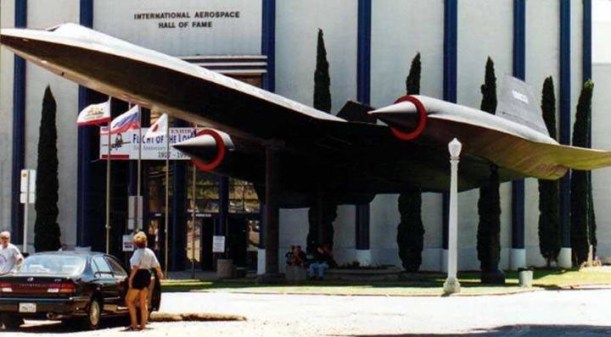
San DiegoAerospaceMuseum
The SR-71 was an expensive aircraft to operate.
The most significant cost was tanker support, and in

1990, confronted with budget cutbacks, the Air
Force retired the SR-71.


The SR-71 served six presidents, protecting America
for a quarter of a century.

Unbeknown to most of the country, the plane flew
over North Vietnam, Red China, North Korea, the
Middle East, South Africa, Cuba, Nicaragua, Iran,

Libya and the Falkland Islands.


On a weekly basis, the SR-71, kept watch over every
Soviet Nuclear Submarine, Mobile Missile Site,
and all of their troop movements.
It was a key factor in winning the Cold War.

I am proud to say, I flew about 500 hours in this
aircraft. I knew her well. She gave way to no plane,

proudly dragging her Sonic Boom through enemy

backyards, with great impunity.


She defeated every missile, outran every MIG,

and always brought us home.

In the first 100 years of manned flight, no aircraft

was more remarkable. The Blackbird had outrun

nearly 4,000 missiles, not once taking a scratch

from enemy fire.

On her final flight, the Blackbird, destined for
the Smithsonian National Air and SpaceMuseum ,
sped from Los Angeles to Washington
in 64 Minutes, averaging 2,145 mph, and
setting four speed records.


Heineken Adverts

Leave a comment

This gallery contains 20 photos


Leave a comment

Dakar Toyota for 2013

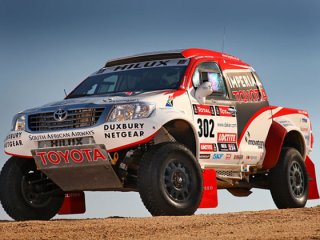
The Toyota Hilux that will compete in the 2013 Dakar Rally will be a completely different beast from the bakkie that clinched third spot in the 2012 event.

Toyota Motorsport team principal Glyn Hall says South African driver Giniel de Villiers and his German co-pilot, Dirk von Zitzewitz, will be driving a new car, with a lower centre of gravity and improved sand performance.

Tested on Namibia’s dunes already, the improved performance on sand comes mainly from a new 5 l engine delivering more than 570 Nm of torque, versus the 4.6 l engine used in 2012, at roughly 510 Nm of torque.

Hall says the extra torque “helps a lot with the performance on sand. When you want to power a car up a 300 m dune, there is no substitute for torque”.

He believes new engine regulations at Dakar 2013, again to be held in South America, will serve as a great equaliser in next year’s rally, as teams must now use production-type engines.

The X-raid Team’s Mini, in which Stéphane Peterhansel in 2012 secured his tenth Dakar victory, sported a prototype engine, and not a production-type engine, says Hall.

“So, Mini will have less performance, and we will have more. Maybe we will meet each other in the middle.”

The second biggest change to De Villiers’ new Hilux is that it is wider.

“When we redesigned the chassis, we explored the regulations some more, and put more structural components lower, thereby lowering the vehicle’s centre of gravity. This also gained us an extra 100 mm (width) inside the cab,” explains Hall.

The new Hilux will also feature new designed-and-made-in-South-Africa lightweight carbon-fibre doors, as opposed to the steel doors used in 2012.

The second Hilux to compete as part of the South African Dakar team will also feature these doors. This vehicle will again be driven by the team of Duncan Vos and Rob Howie, who were tenth overall in the 2012 event.

While De Villiers and Von Zitzewitz gain a new car, Vos and Howie will compete in an upgraded Hilux, featuring a revised suspension, more lightweight parts and a bigger engine.

NEW RACE, NEW TARGET
As Hall and his team have achieved their 2012 ambition of clinching a podium position, the aim over the next three years is now to “try and win this race”, says the Dakar team principal.

Toyota Motorsport announced earlier this year that Imperial Toyota, a member of the JSE-listed Imperial Holdings, had agreed to back the Imperial Hilux team for the next three years, covering the 2013, 2014 and 2015 Dakar Rally, thereby expanding on its 2012 support. The co-sponsors Innovation Group and Duxbury Netgear have also again offered their support.

“If we can improve on last year’s unbelievable performance, we would be very happy,” notes Hall.

He adds, however, that the team is still looking for one last sponsorship partner in order to “meet its budget requirements”.

When looking at the 2013 Dakar Rally, the South African Imperial Hilux team will be facing a number of challenges quite different to the 2012 race.

The 2013 race will start in Lima, Peru, and not Argentina. This also means it will not start out on gravel, but will almost immediately hit some “pretty big dunes”, says Hall.

He says this means it will be a different rally altogether, with bigger gaps likely from the start of the race. It will also place some pressure on the drivers, as dune riding is the most technical part of the rally.

“Navigation is also tricky, as you do not follow a track, but a compass.”

Dakar 2013 starts on January 5, and ends on January 20 in Santiago, Chile.

The South African team will comprise 21 people.

Edited by: Creamer Media Reporter

Picture by: Toyota
The new 2013 Dakar Rally Toyota Hilux

Picture by: Toyota
The Toyota Motorsport and Hallspeed teams tested the new Hilux in the Namibian desert

Picture by: Toyota
South African driver Giniel de Villiers and his German co-pilot Dirk von Zitzewitz

Picture by: Toyota
Toyota Motorsport team principal Glyn Hall

Picture by: Toyota
The new 2013 Dakar Rally Toyota Hilux